89% of retailers are preparing for AI agents that buy, 15% of shoppers would let them pay: what it means for Black Friday
 Alexandre Suon·7 min read·
Talkdesk's holiday survey, published on 4 November, shows a clear gap: retailers are preparing agents that buy on the customer's behalf, while shoppers mostly want AI that helps them choose. The numbers, what they say about the journey, and what to test before the peak.
In this articleShow all sectionsHide
30-second summary
ShowHide ⌄
- On 4 November 2026, Talkdesk published its "2026 AI Holiday Shopping Survey", run by Centiment in September among 1,048 online shoppers and 312 retail leaders in the US.
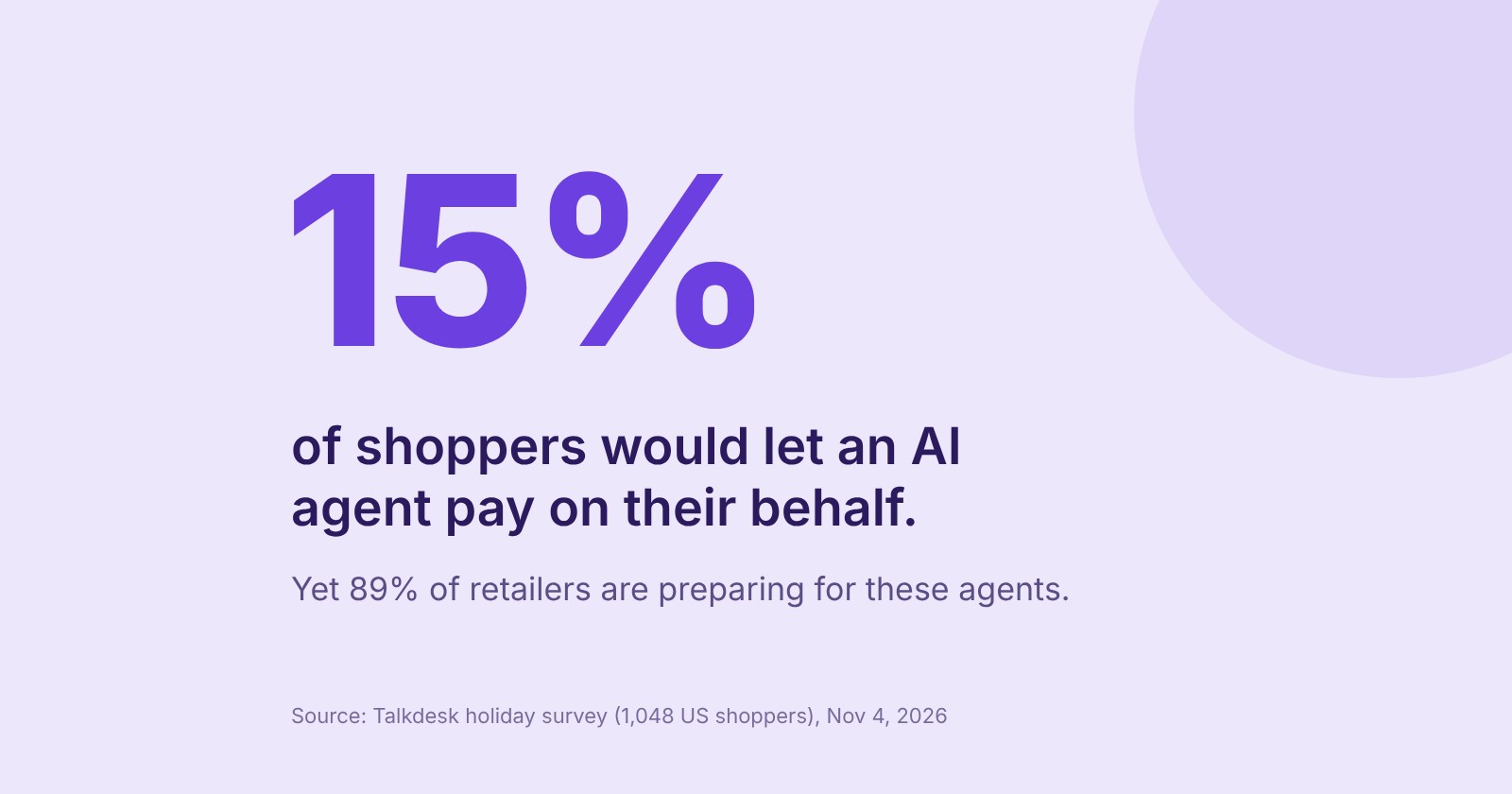
- 89% of retailers are preparing for AI agents that shop on the customer's behalf. But only 15% of shoppers would let an agent pay with their payment details, even if they reviewed the transaction first. 10% without a review step.
- On the other hand, 74% of shoppers plan to use an AI assistant for shopping this season, and 49% are willing to buy from an unfamiliar brand on its recommendation.
- Trust is the weak spot: 77% of shoppers want to know when AI is involved, and 37% of retailers do not fully disclose it.
- For Black Friday 2026, AI recommends and payment still happens on the brand's site. The landing page of that visitor, often a product page, matters more than agent payment.
Section 1 · The survey
Talkdesk measures the gap between what retailers prepare and what customers accept
Talkdesk, a customer-experience software vendor, published its "2026 AI Holiday Shopping Survey" on 4 November 2026. The survey was run by Centiment in September 2026 in the US.
- 1,048 adults who plan to shop online for the holidays, for themselves or others.
- 312 retail leaders, director level or above, at companies with 50 or more employees that use AI.
The vendor's message fits in one sentence: shoppers happily use AI to find ideas and deals, but refuse to hand over execution, and above all payment.
Agentic commerce, in plain words Agentic commerce is when an AI agent no longer just advises but acts for the customer: it compares, fills the cart and pays. The big platforms are working on it. Talkdesk's survey measures whether shoppers are ready to let it happen.
Section 2 · The numbers
AI that advises is adopted, AI that pays is not
The contrast is sharp. Nearly nine retailers in ten are preparing agents that buy for the customer. But only 15% of shoppers would let an agent pay with their payment details, even after reviewing the transaction. Without that step, it drops to 10%.
Discovery, by contrast, is already adopted: 74% plan to use an AI assistant for shopping this season, and 49% are willing to buy from a brand they don't know if AI recommends it.
“For Black Friday 2026, AI recommends. Payment still happens on the brand's site.”
Section 3 · Trust
77% of shoppers want to know when AI is involved, 37% of retailers do not fully say so
The survey also shows a transparency gap. 77% of shoppers want to know when AI is part of their shopping experience. Yet 37% of retailers do not fully disclose it.
Among the 74% of shoppers asking for stronger AI rules, concerns are unauthorised personal data collection (55%), paid product placement (41%) and being charged a different price than another shopper (41%).
Why this is a conversion issue A visitor who doubts what they are shown hesitates longer and drops off more often. Saying clearly when a recommendation comes from AI, and what it is based on, is part of the purchase journey, just like price or delivery time.
Section 4 · The journey
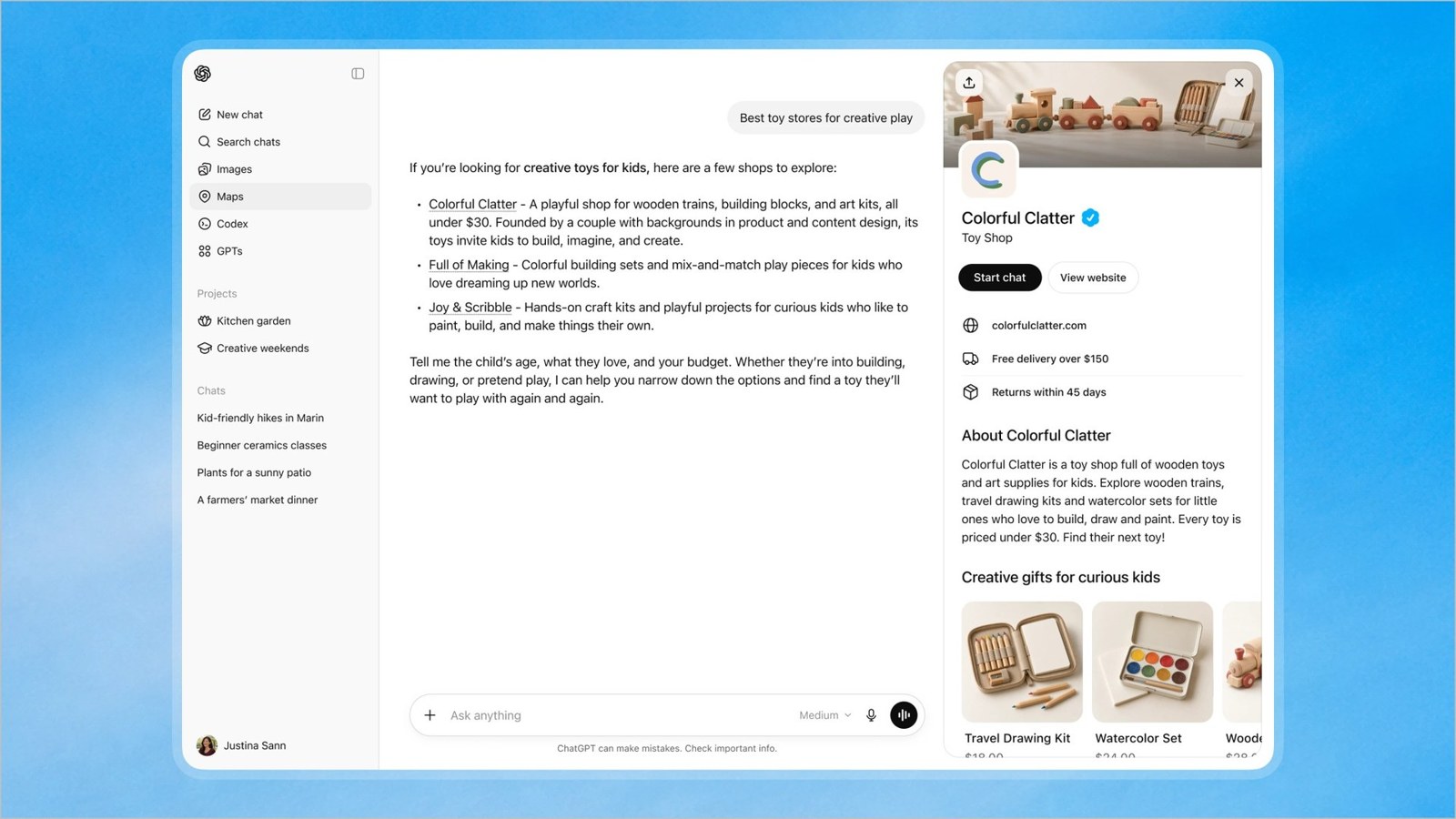
The visitor sent by AI lands on a product page with a precise question
If AI recommends but does not pay, the customer completes the purchase on your site. And they don't arrive like a regular visitor: they have already compared, they have a precise question, and they usually land straight on a product page.
- 1The question to the assistant"What gift for…?", "Which model for this use?" The assistant compares several brands.
- 2The recommendationA handful of products, sometimes from a brand the shopper did not know.
- 3The landing on the product pageThe shopper checks it is the right product: price, delivery time, returns, availability. Then they pay, or they leave.
For this traffic, the product page acts as the home page. It must answer right away the questions of someone who has already chosen: is this the right product, how much, when, and what happens if it doesn't work out.
Section 5 · To do
Three workstreams before Black Friday
- Isolate traffic from AI assistants in your analytics. Part of it arrives without a referrer and ends up in "direct": create a dedicated channel for known referrers and track the share of "direct" landing on product pages.
- Review the product pages this traffic visits most: price, delivery time, return policy and availability visible without scrolling.
- Test these pages before investing in agent payment: an A/B test on the order and visibility of this information, measured on revenue per visitor.
| Workstream | Why now | What to measure |
|---|---|---|
| "AI assistants" channel in analytics | Without it, you can't know what this traffic is worth | Sessions, conversion and revenue per visitor for the channel |
| Landing product pages | This is where the AI-guided shopper decides | Revenue per visitor, back-navigation rate |
| Transparency about AI | 77% of shoppers want to know when it is involved | Drop-offs and customer service contacts |
| Agent payment | Only 15% of shoppers would accept it | Keep watching, not a priority this season |
Key terms
ShowHide ⌄
- Agentic commerce
- Purchases made by an AI agent on the customer's behalf: search, comparison, cart and payment.
- AI agent
- A program that acts for someone, using tools and data, beyond simply answering a question.
- Direct traffic
- Visits the analytics tool cannot attribute to any source. Part of the traffic from AI assistants ends up there.
- Revenue per visitor
- Revenue divided by the number of visitors. It combines conversion and average order value, and serves as a test's main metric.
- Product page
- The page presenting a product: price, photos, description, availability, delivery and returns.
Sources
ShowHide ⌄
Alexandre co-founded and runs Henkan & Partners. He decodes one e-commerce story every day on LinkedIn.
Follow Alexandre ↗