ChatGPT now tells brands how often it cites them: what Business Hub measures, and what it doesn't
 Alexandre Suon·8 min read·
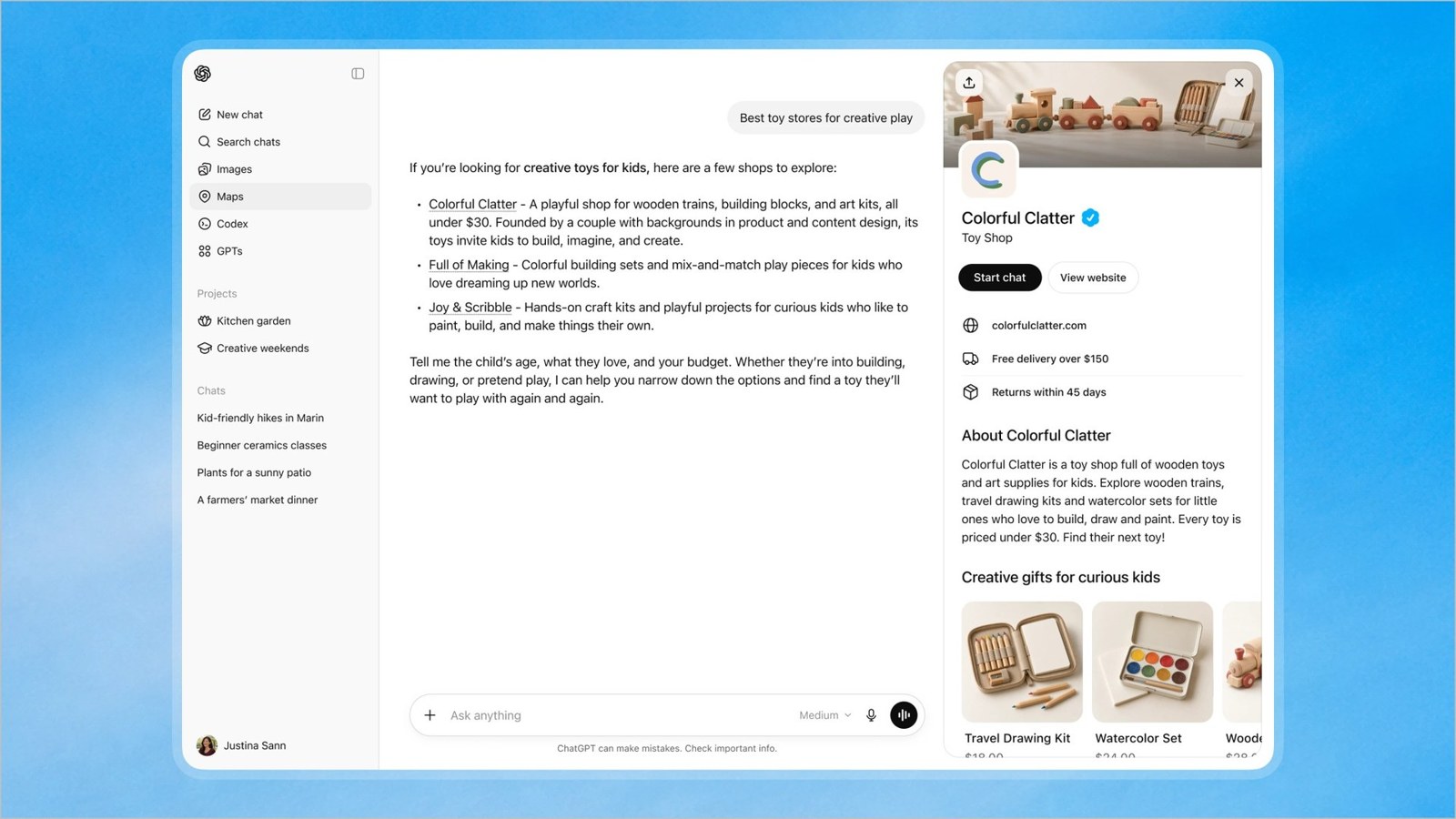
With "Businesses in ChatGPT", OpenAI gives verified businesses the number of times ChatGPT mentions them, the clicks to their site and the topics of the conversations they appear in. A first for AI visibility. What these numbers say, what they leave out, and how to tie them back to your sales.
In this articleShow all sectionsHide
30-second summary
ShowHide ⌄
- On 10 November 2026, OpenAI launched "Businesses in ChatGPT" in beta: businesses can claim their listing in a space called Business Hub.
- Once verified, they see aggregated insights on their mentions, clicks to their website and common topics in the conversations where they are cited.
- Until now, visibility in ChatGPT was estimated, with third-party tools asking hundreds of prompts. For the first time, the source gives its own numbers.
- OpenAI does not define what counts as a mention, and a click guarantees neither a visit nor a purchase.
- The right move: reconcile the reported clicks with the sessions in your analytics, then follow what those visitors buy.
Section 1 · The announcement
ChatGPT opens a space for brands, with their own numbers
On 10 November 2026, OpenAI introduced Businesses in ChatGPT, in beta. The idea is simple. A business claims its listing in a space called Business Hub, gets verified, then keeps its details up to date. It can also add product feeds with current pricing and availability.
The announcement has a second part: the Business Agent, an assistant the brand sets up to answer customer questions about its products. These exchanges happen in a clearly labelled conversation, separate from ChatGPT's own answers. For now, Business Agents are only available to eligible ecommerce and online service businesses in the US. Claiming a listing is open to eligible businesses wherever ChatGPT is available.
According to The Next Web, verified listings get a badge, brands can edit their prices and stock, and an agent can be used as the destination of a ChatGPT Ads campaign. The Next Web also reports that agents must disclose they are AI, purchases need the user's explicit approval, and checkout still happens on the brand's own site.
What is GEO? Generative Engine Optimization. The work of getting a brand to show up in the answers of AI assistants (ChatGPT, Gemini, Perplexity), the way SEO targets Google results. A "citation" or "mention" is when the assistant names the brand or links to its site in an answer.
Section 2 · The numbers
For the first time, the source gives its own numbers
This is the newest part for an e-commerce team. Once verified, a business gets, in OpenAI's words, aggregated insights on mentions, website clicks, and common topics in conversations where it is cited.
Until now, nobody really knew how often ChatGPT cited a brand. GEO tracking tools work by estimation: they ask the assistant hundreds of sample prompts, note which brands come up and work out a share of visibility. The method is useful, but it depends on the prompts chosen, and real conversations stay out of sight.
Estimates versus reported numbers A third-party tool measures a sample of prompts it wrote itself. Business Hub counts across real conversations, but under rules OpenAI does not spell out. The two work together: one tells you where you are cited, the other lets you test specific prompts, including on your competitors.
On privacy, OpenAI is clear: it does not share people's conversations or Business Agent chats with businesses. The brand sees totals and themes, never a conversation.
Section 3 · The limits
What the dashboard measures, and what it doesn't
A number is only worth something if you know how it is built, and several points are still unclear. According to The Next Web and PPC Land, OpenAI does not say what counts as a mention or how it is calculated. According to PPC Land, insights only appear once there are enough conversations to meet a threshold OpenAI has not quantified, and views cover 7 or 28 days.
| The dashboard measures | It doesn't measure |
|---|---|
| How many times the brand is mentioned | How it is presented: first choice, alternative, or with a caveat |
| Clicks to the website | The visits that actually arrived, or what they did next |
| Common topics where the brand is cited | Topics where it should be cited and a competitor takes its place |
| Aggregated totals | What the conversations say, which OpenAI does not share |
| Visibility in ChatGPT | Sales, margin, loyalty |
On clicks, PPC Land points out that OpenAI says so itself on its sign-up page: clicks don't confirm website visits or conversions. Between the click in ChatGPT and the page loading, some visitors drop off, and others arrive without being recognised as coming from ChatGPT.
Section 4 · The risk
Citations could become the new vanity KPI
A new number that is simple and flattering tends to end up in the monthly report. ChatGPT mentions have everything it takes: they go up, they compare month on month, and they look good in a board meeting.
The trouble is that a citation earns nothing. Neither does a click. A brand can be cited often on topics that bring no buyers, or cited with a caveat that sends people elsewhere. On the other hand, a handful of mentions on one specific question, right before a purchase, can weigh heavily in revenue.
- Optimising for mentions pushes you towards volume, not the quality of visitors.
- Comparing mentions across brands makes little sense while the definition stays vague.
- Reporting clicks as traffic overstates what actually reaches the site.
“The value of AI visibility is still measured after the click.”
Section 5 · The method
Reconcile ChatGPT clicks with your sessions, then with your sales
Your analytics tool already sees part of this traffic. According to OpenAI's help centre, ChatGPT automatically adds the utm_source=chatgpt.com parameter to the links it sends to websites. Those visits can be identified, on top of referral traffic from chatgpt.com.
- Build a ChatGPT segment in your analytics: sessions with utm_source=chatgpt.com or a chatgpt.com referrer.
- Compare, over the same 7 or 28 days, the clicks reported in Business Hub with the sessions you measure. The gap tells you how many visitors drop off or arrive untagged.
- Keep an eye on direct traffic: a ChatGPT visit that loses its tag lands there.
- Follow what these visitors buy: conversion rate, average order value, products, share of new customers.
- Compare with your other channels before concluding that ChatGPT brings better or worse customers.
UTM parameters and referrers A UTM parameter is a label added to the end of a link (for example ?utm_source=chatgpt.com) that your analytics tool reads to credit the visit to a source. The referrer is the address of the page the visitor came from, passed on by the browser. When both are missing, the visit is classed as direct.
Section 6 · Where to start
Where to start this week
- 1Claim your listingIf your business is eligible, claiming is open wherever ChatGPT is available. Check the details and prices shown while you are at it.
- 2Set a baseline in your analyticsBuild the ChatGPT segment and note its current sessions, orders and revenue before you change anything.
- 3Reconcile the two sources every monthBusiness Hub clicks on one side, measured sessions and sales on the other. Track the gap rather than each number on its own.
- 4Read the topics, then list the gapsLook at the topics where you are cited, then the ones where you should be: your key categories, the questions people ask before buying. The second list is your GEO roadmap.
Key terms
ShowHide ⌄
- GEO
- Generative Engine Optimization: the work of showing up in AI assistants' answers, the way SEO targets search engines.
- Mention
- An appearance of the brand in a ChatGPT answer. OpenAI has not published a precise definition.
- Business Hub
- The space where a business claims and manages its ChatGPT listing and checks its insights.
- Business Agent
- An assistant set up by the brand to answer customers inside ChatGPT. For now, open to eligible businesses in the US.
- UTM parameter
- A label added to a link so your analytics tool knows where a visit came from.
- Vanity KPI
- A metric that goes up and reassures, but says nothing about real performance such as sales or margin.
Sources
ShowHide ⌄
- OpenAI, "Introducing Businesses in ChatGPT", 10 November 2026
- OpenAI Developer Community, "Introducing Businesses in ChatGPT (in beta)", 10 November 2026
- OpenAI Help Center, "Publishers and developers FAQ"
- The Next Web, on the launch of Business Agents in ChatGPT
- PPC Land, "Businesses gain ChatGPT click and mention counts in OpenAI's Business Hub", 11 November 2026
Alexandre co-founded and runs Henkan & Partners. He decodes one e-commerce story every day on LinkedIn.
Follow Alexandre ↗