AI agents: opening or closing your store has become a leadership decision
 Alexandre Suon·10 min read·
Amazon blocks agents it has not authorized. BigCommerce welcomes them by default. Walmart picks its partners. What MCP and WebMCP are, what each stance changes for conversion, promotions and measurement, and how to decide for your own store.
In this articleShow all sectionsHide
30-second summary
ShowHide ⌄
- On October 21, 2026, Commerce and Cloudflare turned on WebMCP by default for eligible BigCommerce stores: AI agents in the shopper's browser can search, compare and add to cart.
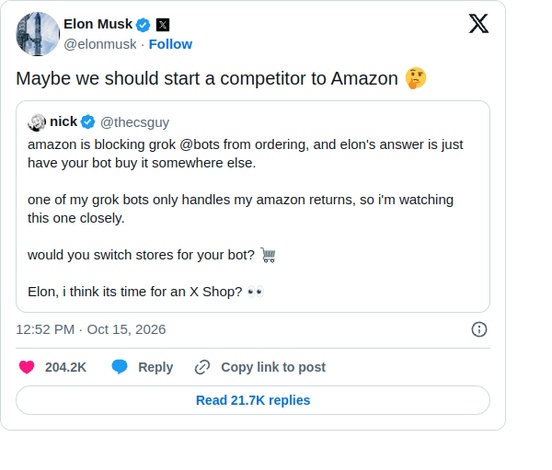
- Amazon does the opposite. It blocked Meta's Muse agent, saying that access by an unauthorized agent violates its Conditions of Use. Users also report that Grok agents can no longer place orders there.
- Walmart took a third path: it was among the retailers added to Muse in September 2026, while it keeps building its own assistant, Sparky.
- Each stance has a cost: on conversion, on promotions and upsell, on customer data and on what you can measure.
- There is no universal right answer. The real risk is letting a default setting decide for you.
Section 1 · The news
BigCommerce opens its stores to AI agents, without asking merchants first
On October 21, 2026, Commerce (the Nasdaq-listed company behind BigCommerce) and Cloudflare announced WebMCP for BigCommerce stores. In practice, an AI agent running in a shopper's browser can now search products on the site, compare them and add them to the cart on the shopper's behalf.
The press release gives a simple example. A shopper asks their agent for a lightweight jacket in their size, under $150. The agent finds a product on a BigCommerce store, adds it to the cart and hands the shopper a link to checkout on the merchant's site.
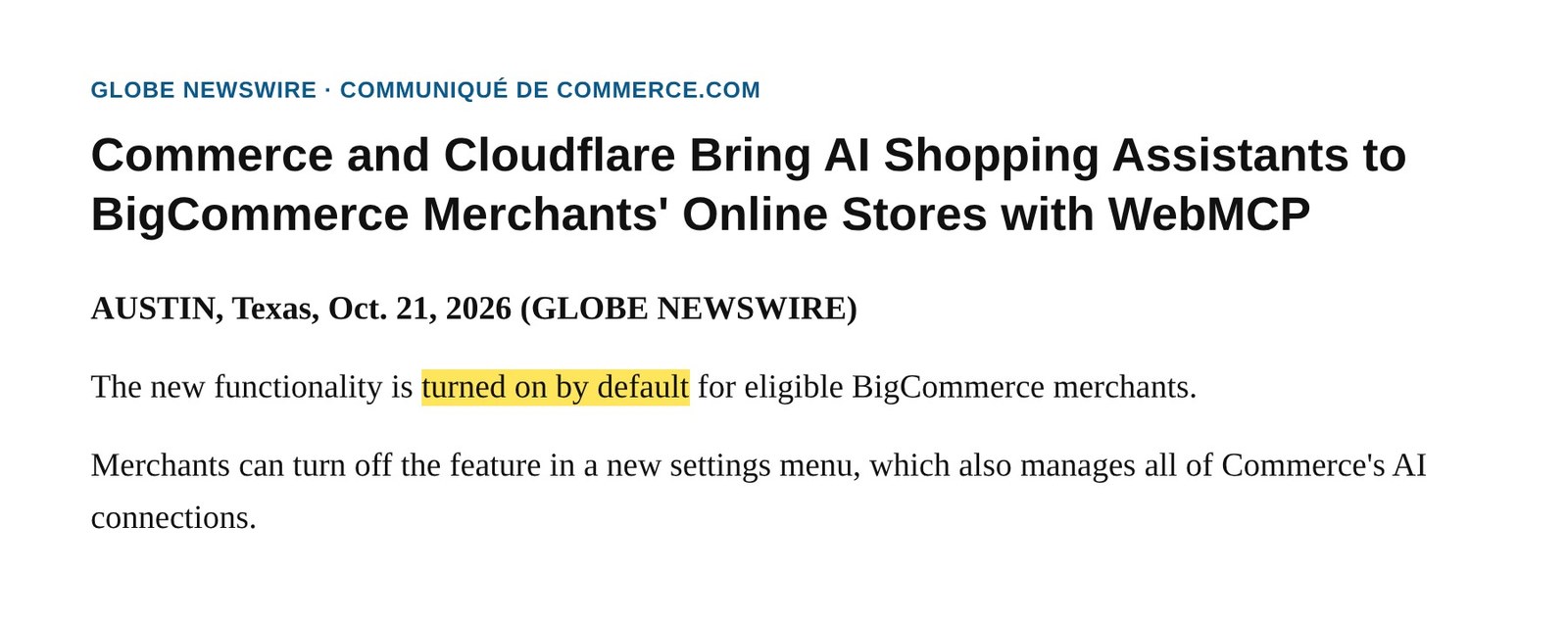
The line that matters for an e-commerce director is this one: the feature is “turned on by default for eligible BigCommerce merchants.” No code to write, no change to the site. Merchants who do not want it can turn it off in a new settings menu, which also manages all of Commerce's AI connections.
What stays with the merchant According to the release, prices and stock come straight from the store, and “checkout, the customer relationship and the brand stay with the merchant.” The agent prepares the purchase. The shopper still pays on your site.
Section 2 · Explainer
MCP and WebMCP hand agents a user manual for your store
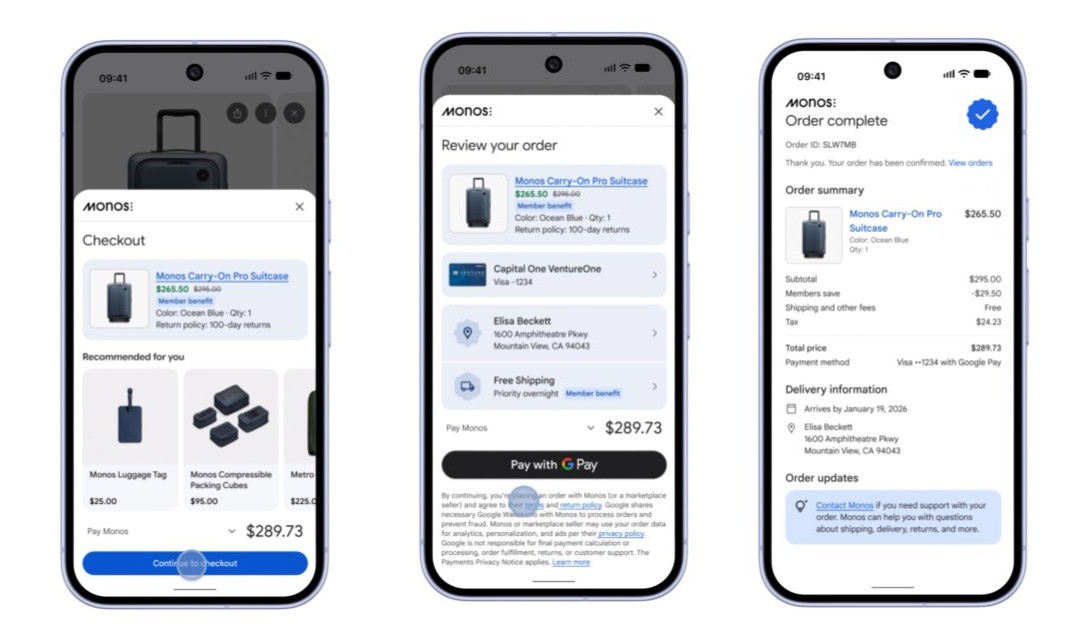
An AI agent that shops has a problem: e-commerce sites are built for humans. It has to guess where the search bar is, which button adds to cart, which size is in stock. It reads the page like a picture, often gets it wrong, and the site may take it for a malicious bot.
MCP (Model Context Protocol) is an open standard, introduced by Anthropic in November 2024, for connecting AI assistants to the systems where data lives. Instead of guessing, the agent receives a list of possible actions, clearly described: “search for a product”, “check stock”, “add to cart”. WebMCP brings that idea to the web page itself: the site tells the browser agent directly what it sells and what it can do.
- 1Storefront MCPs, server sideFor agents connecting from outside the store, for example an assistant inside a chat app.
- 2WebMCP, in the browserFor agents running in the shopper's browser while they are on the site. This is the October 21 addition.
- 3Checkout, on the merchant's siteEither way, the agent sends the shopper back to the store's own checkout.
Sharon Gee, who leads AI product at Commerce, sums up the intent: WebMCP “replaces guessing with a handshake.” The site and the agent agree on what is possible, instead of the agent feeling its way around.
Section 3 · The stances
Amazon closes, BigCommerce opens, Walmart picks its partners
The same week, Amazon showed the opposite stance. It blocked Meta's Muse agent, launched in September 2026 and able to shop for its user. In a statement quoted by Cybernews, Amazon said that “continued access by an unauthorized AI agent violates Amazon's Conditions of Use, to which our customers have agreed.” In mid-October, users also reported that Amazon was stopping agents from Grok, xAI's assistant, from placing orders. Amazon has not confirmed that second block.
Walmart took a third path. On September 24, 2026, Meta announced it was adding Walmart to Muse, alongside Best Buy, Sephora, Ulta, Wayfair and American Eagle Outfitters. At the same time, Walmart is building its own assistant, Sparky, in its app since June 2025, which helps shoppers find products and sums up reviews.
| Stance | Who | What it means |
|---|---|---|
| Open by default | BigCommerce (WebMCP) | Any browser agent can search and fill the cart, unless the merchant turns the option off. |
| Closed | Amazon | Unauthorized agents are blocked. Shoppers have to come to the site themselves. |
| Open on your terms | Walmart | Access granted to chosen partners (Muse), while keeping its own assistant (Sparky). |
Why Amazon can afford to close Amazon is a destination in itself: its customers come to it directly. It does not need other companies' agents to be found. An average brand does not have that leverage: if it closes, the shopper's agent buys somewhere else.
Section 4 · The impact
Each stance is paid for in conversion, promotions, data or measurement
Nobody knows yet how much agents will sell. None of the three companies has published sales figures for purchases made through agents. But we can already describe what each stance shifts on four topics an e-commerce director tracks every day.
| Topic | Open by default | Closed | Open on your terms |
|---|---|---|---|
| Conversion | You capture shoppers who go through an agent, but the agent decides fast and compares hard. | You keep the journey you optimized, and lose shoppers who no longer want to search themselves. | You capture the agents that matter to your customers, without putting up with the rest. |
| Promotions and upsell | Banners, cross-sell and bundles get skipped if the agent does not see them as actions. | Your merchandising stays intact for those who visit. | You can negotiate what the agent sees and suggests. |
| Customer data | Checkout stays with you, but search and hesitation happen inside the agent. | You keep all browsing data. | It depends on the contract with each partner. |
| Measurement | Part of your traffic becomes agents: conversion rates and A/B tests change meaning. | Your metrics stay comparable over time. | Measurable per partner, if you plan for it. |
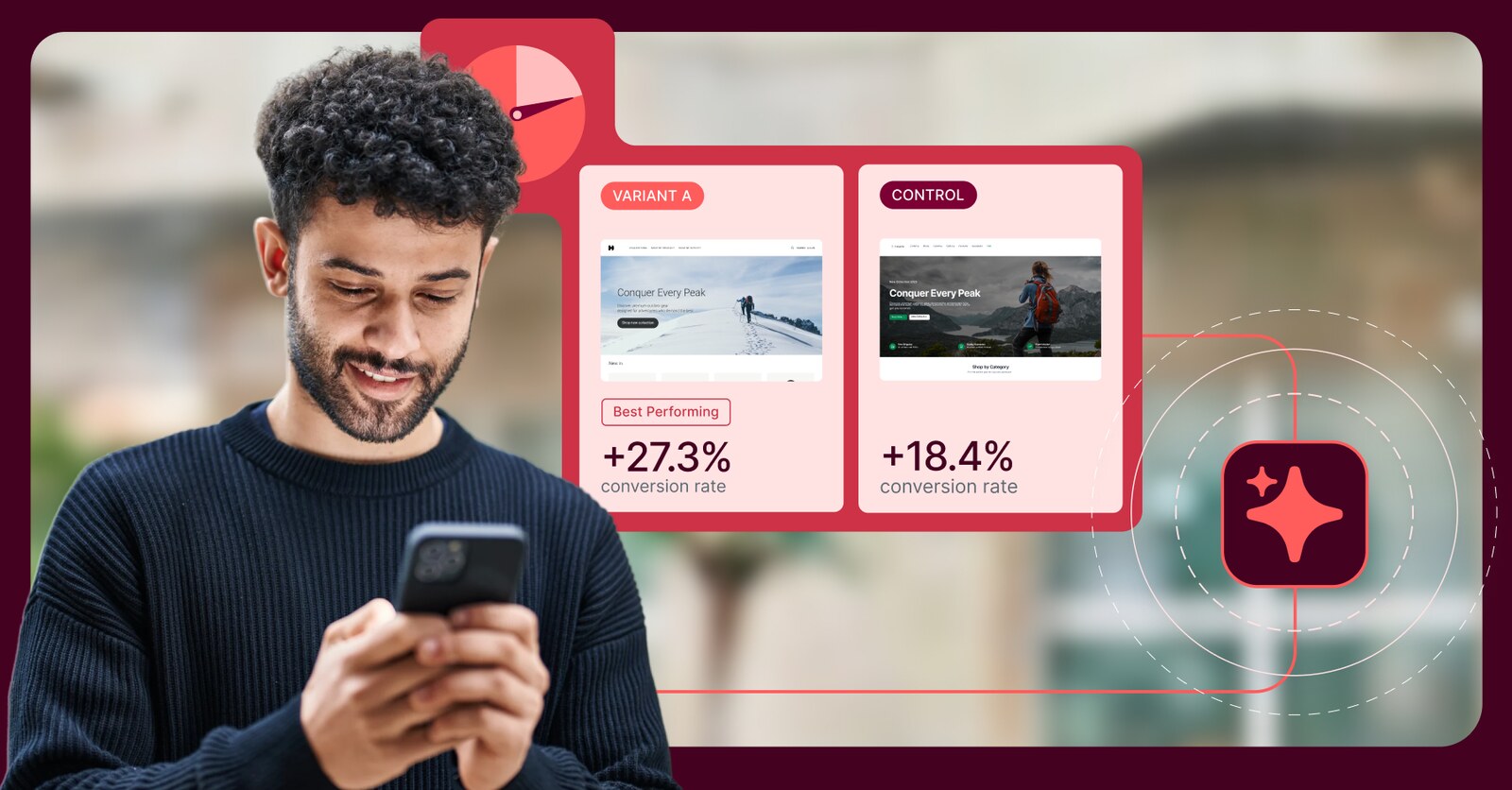
The most underestimated topic is measurement. An agent does not see your free-shipping banner, does not click “complete the look” and does not come back three times to the product page. If its traffic blends with human traffic without being flagged, your dashboards and A/B tests measure a mix nobody chose.
“The default setting is already a decision. The only question is who made it.”
Section 5 · The decision
The decision belongs to e-commerce leadership, with a name and criteria
On BigCommerce, the choice comes down to a switch in a settings menu. That is exactly the danger: the decision can be made by a developer, an agency or nobody at all. Yet it affects revenue, margins, data and the brand. Here are the questions to settle before leaving the switch one way or the other:
- Who owns the decision? One named person in e-commerce leadership, with legal and data at the table. The tech team should not decide alone.
- What is our stance today? Check what your platform has turned on by default, and what your robots.txt file and bot-protection tool let through.
- Which agents matter to our customers? The ones they actually use, rather than the ones in the headlines.
- What should the agent see? Prices, stock, promotions, bundles: anything not exposed as an action may be ignored.
- How do we recognize agent traffic? Without tagging, you cannot measure what it brings or what it breaks.
- What are the limits? Excluded products, maximum quantities, return conditions: what an agent must never do on your store.
Section 6 · The test
Open on a limited scope, and measure before rolling out
Between opening everything and closing everything, there is a more careful option: open part of the catalog or part of the traffic, with measurement planned in advance. It is the logic of an A/B test, applied to an access decision.
This test will not tell you what agents will sell in three years. It will tell you, on your own store, whether a cart filled by an agent turns into an order, at what order value, with what returns. That is enough to move from a setting you inherited to a decision you own, and to revisit it as the numbers come in.
Key terms
ShowHide ⌄
- AI agent
- A program that acts for a user: it searches, compares, fills a cart and sometimes pays, following an instruction.
- MCP (Model Context Protocol)
- An open standard for connecting an AI assistant to tools and data, by describing the actions available to it.
- WebMCP
- A standard that lets a web page tell the browser agent directly what it sells and what it can do there.
- On by default (opt-out)
- A feature switched on from the start: you have to act to turn it off, rather than act to turn it on.
- Conditions of Use
- The rules a customer accepts to use a site. Amazon relies on them to ban unauthorized agents.
- robots.txt
- A file at the root of a website that tells bots which pages they may visit.
- Agent traffic
- Visits and actions made by an AI agent rather than a person. Track it separately to keep your metrics reliable.
Sources
ShowHide ⌄
- Commerce and Cloudflare, “Commerce and Cloudflare Bring AI Shopping Assistants to BigCommerce Merchants' Online Stores with WebMCP”, press release, October 21, 2026 (GlobeNewswire)
- Cybernews, Amazon statement on Muse and user reports on Grok, October 16, 2026
- Meta, “The Biggest News From Connect 2026”, September 24, 2026
- Meta, “Introducing Muse: The World's First Personal AI Agent Built for Everyone”, September 8, 2026
- Walmart, “The Future of Shopping Is Agentic. Meet Sparky.”, June 6, 2025
- Anthropic, “Introducing the Model Context Protocol”, November 25, 2024
Alexandre co-founded and runs Henkan & Partners. He decodes one e-commerce story every day on LinkedIn.
Follow Alexandre ↗