Amazon shuts the door on AI agents: who gets to buy on your site?
 Alexandre Suon·5 min read·
According to users, Amazon is stopping Grok agents from placing orders. Elon Musk replies that maybe he should start a competitor. What a shopping agent is, how a site lets it in or keeps it out, and the decision every brand has to make.
In this articleShow all sectionsHide
30-second summary
ShowHide ⌄
- On October 15, 2026, Grok users complained on X that Amazon blocks their agents when they try to place orders. Amazon has not confirmed a Grok-specific block.
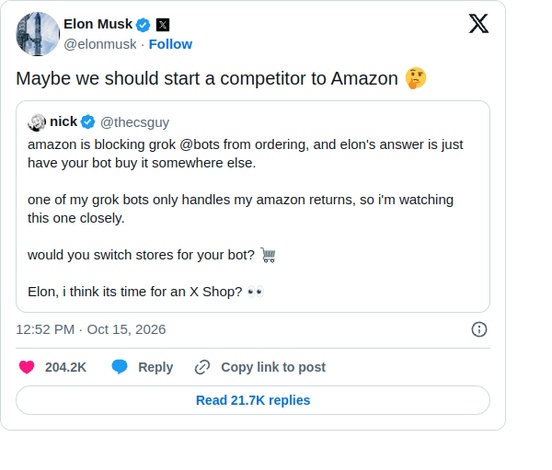
- Elon Musk replied: “Maybe we should start a competitor to Amazon”.
- Amazon already pushed Meta's Muse agent out in September, citing its Conditions of Use. A few days later, Meta listed Walmart among Muse's retailers.
- A site decides who gets in with three tools: the robots.txt file, its terms of use and bot management.
- Letting agents buy and blocking them both have a cost. The right choice is made on purpose, then measured.
Section 1 · The facts
Grok agents turned away, and Musk floating an Amazon rival
On October 15, 2026, an X user, @thecsguy, wrote that Amazon is blocking Grok bots from ordering. He added that one of his agents only handles his Amazon returns. An hour and a half later, Elon Musk, whose company xAI builds Grok, quoted the post: “Maybe we should start a competitor to Amazon”.
Precision matters here. The block is reported by users. Amazon has made no statement about Grok, and Musk's line is not an announcement. What we can check: Amazon's robots.txt file, which we read on October 21, 2026, tells the GrokBot, Grok-DeepSearch and xAI-Grok robots not to visit any page of the site.
Amazon has taken this stance in public before. In late September 2026, users of Muse, Meta's personal agent, saw this message on Amazon: “Continued access by an unauthorized AI agent violates Amazon's Conditions of Use, to which our customers have agreed.” Amazon asked Meta to remove Amazon from Muse. On September 24, Meta announced new retailers connected to Muse, including Walmart, Best Buy and Sephora.
Section 2 · The agent
A shopping agent does the shopping for the customer
A shopping agent is an AI assistant you hand a whole task to: “reorder the same coffee pods as last month”, “find this sweater in a medium at the best price”, “send this parcel back”. The agent visits sites, compares, fills the cart and, if the customer allows it, pays.
For the retailer, the visitor changes. The program goes straight to the requested product, reads the price and stock, then moves on. It never looks at the photos, the promo banner or the suggested products.
Crawler or agent? A crawler (like the ones search engines use) reads the site to index it and never buys anything. An agent acts for one specific customer at one specific moment: it signs in, adds to cart, places the order. Both can belong to the same company under different names.
Section 3 · The gates
Three tools decide who gets in: robots.txt, terms of use, bot management
A site has three levels of filtering, from the lightest to the strictest.
| Tool | What it is | Its limit |
|---|---|---|
| robots.txt | A public file at the root of the site that lists, robot by robot, which pages are allowed or off limits. | It is an instruction. A well-behaved robot follows it; nothing technically forces it to. |
| Terms of use | The contract the customer accepts. It can forbid access by unauthorized agents. | It gives a legal basis but blocks nothing in real time. |
| Bot management | A tool, often supplied by the host or CDN, that spots automated visitors and lets them through, slows them down or blocks them. | It needs tuning: too strict and it blocks humans too; too loose and everything gets through. |
Amazon uses at least the first two. Its robots.txt bars the whole site to about a hundred named robots, including Grok's, ChatGPT-User (ChatGPT's agent), Claude-User (Claude's), GoogleAgent-Shopping and meta-externalagent. And its Conditions of Use are the basis for the message shown to Muse users.
When nobody has decided Many e-commerce sites run a robots.txt written years ago, or generated by default by their platform. It may block useful agents, or let in agents nobody chose to welcome. Either way, a technical file is settling a commercial question.
Section 4 · The decision
Letting agents buy or blocking them: both choices have a cost
Amazon can afford to close the door: its customers are used to coming back. For a smaller brand, the trade-off looks different.
| Choice | What you gain | What you lose |
|---|---|---|
| Let agents buy | A sale you might not have had, with no effort from the customer. | Your product page, your promotions, your upsells, and part of the customer relationship. |
| Block them | Control over the experience, your prices and your customer data. | A customer who delegates shopping to an agent may simply buy elsewhere. |
Either way, the e-commerce team should own the decision and track it with numbers. Four questions to start:
- Who wrote your robots.txt, and when? Read it with your tech team and list the AI agents it allows or blocks.
- What does your bot management tool see? How many visits come from agents, on which pages, with what block rate.
- How many orders already come from agents? Isolate them in your analytics to track their average order value and return rate.
- What do you lose by blocking? Test on one period or one category before rolling it out.
“Amazon chose who gets to buy from it. On your site, if nobody has decided, your robots.txt decides for you.”
Key terms
ShowHide ⌄
- Shopping agent
- An AI assistant that completes a purchase for a customer: search, comparison, cart, and sometimes payment.
- robots.txt
- A public file at the root of a site telling each robot which pages it may or may not visit. It is an instruction, with no technical enforcement.
- User agent
- The name a robot or browser gives the site it visits, for example GrokBot or ChatGPT-User.
- Terms of use
- The contract a customer accepts by using a site. It can set rules for access by automated programs.
- Bot management
- A tool that spots automated visitors and decides whether to let them through, slow them down or block them.
- Agentic commerce
- Commerce where AI agents buy on behalf of customers.
Sources
ShowHide ⌄
- @thecsguy on X, October 15, 2026
- Elon Musk on X, “Maybe we should start a competitor to Amazon”, October 15, 2026
- Cybernews, “Musk teases Amazon rival amid Grok Bot block”, October 16, 2026
- Gizmodo, “Amazon brings down the hammer on Meta's Muse AI agent”, September 21, 2026
- Meta, “The Biggest News From Connect 2026”, September 24, 2026
- Amazon, robots.txt file (read on October 21, 2026)
Alexandre co-founded and runs Henkan & Partners. He decodes one e-commerce story every day on LinkedIn.
Follow Alexandre ↗