Contentsquare separates humans from AI agents: what it changes for your A/B tests and KPIs
 Alexandre Suon·8 min read·
Part of your traffic is not human, and it is mixed into your conversion rates, tests and journeys. Contentsquare has just relaunched its platform to measure it separately. What was announced, why it matters in e-commerce, and the questions to ask your team.
In this articleShow all sectionsHide
30-second summary
ShowHide ⌄
- On October 13, 2026, Contentsquare relaunched its analytics platform. It now analyzes LLM and AI agent traffic separately, alongside human sessions.
- The new platform is in beta for selected customers. Broader access will roll out in phases.
- DataDome counted 7.9 billion AI agent requests on its network in January and February 2026. Agentic browser traffic targets e-commerce and retail first, about 20% of the volume.
- An agent does not look at your promo banner and does not scroll. Mixed in with humans, it blurs conversion rates, A/B tests, journeys and heatmaps.
- The reflex to have this week: ask your team what share of traffic is not human, and how it is kept out of tests and KPIs.
Section 1 · The news
Contentsquare relaunches its platform to track humans and agents
Contentsquare is one of the most widely used customer experience analytics tools in e-commerce. It records what visitors do on a website or app: where they click, how far they scroll, where they get stuck. On October 13, 2026, the company announced a reimagined platform, presented as built to understand and optimize “human and agent journeys”.
The new feature that matters here is called human, LLM and agent interactions analytics. According to Contentsquare, it separates traffic coming from LLMs and AI agents and analyzes it alongside human sessions. The stated goal: optimize journeys for visits sent by AI assistants and for agentic commerce, on top of human visitors.
- Automated WebMCP monitoring: it captures the activity of autonomous agents using this new standard, activity that “most tools can't see at all”, according to Contentsquare.
- Multi-touch attribution: it spreads the credit for a sale across every touchpoint, including LLM-referred traffic, instead of giving it all to the last click.
- Conversation analytics: chatbots, voice and text conversations are linked to friction points on the site and in the app.
- Sense, the platform's AI layer, can now form hypotheses, launch tests and validate their impact, with a human approving.
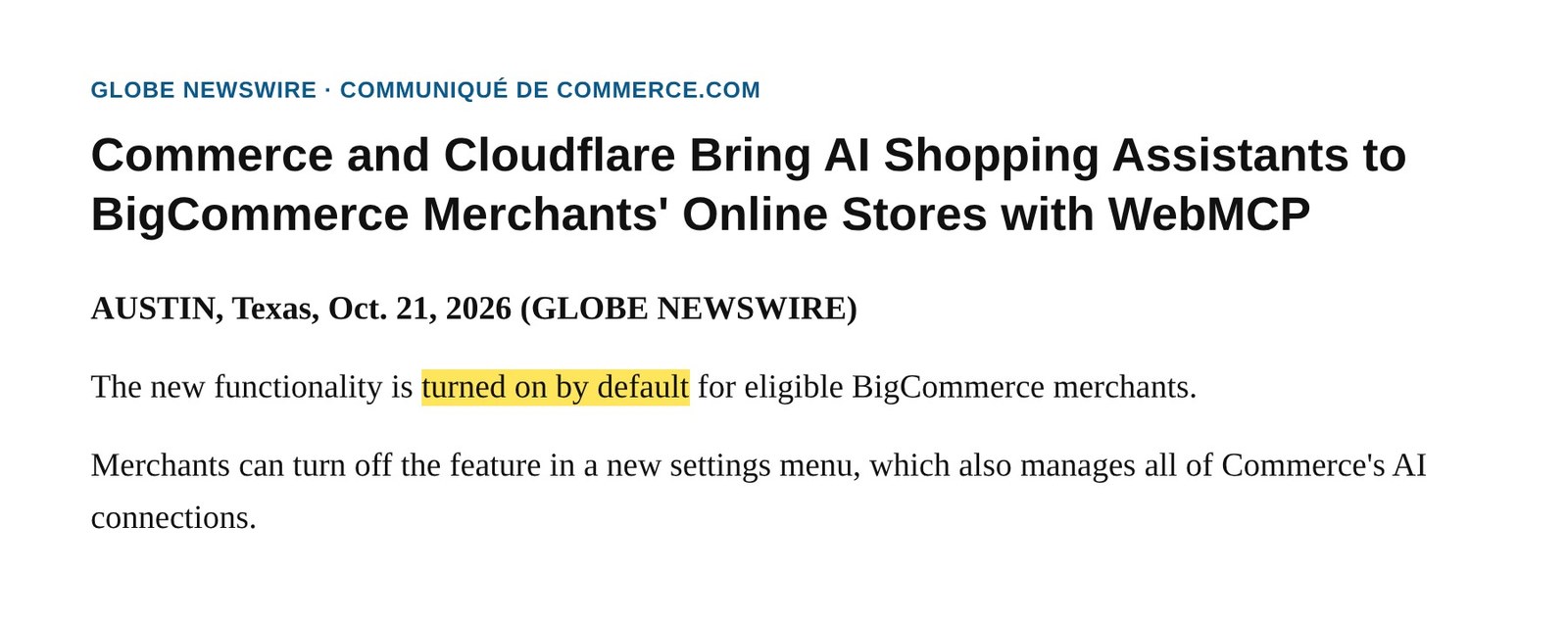
Contentsquare also announced deeper integrations with testing and personalization tools, including Dynamic Yield, Optimizely and Kameleoon. The platform is in beta for selected customers. Broader access will follow in phases, with no specific date.
Section 2 · The context
Billions of AI agent requests, with e-commerce on the front line
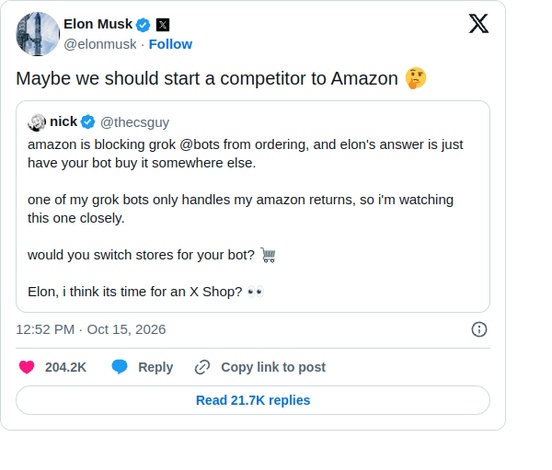
Why now? Because AI agents are already here, in volume. DataDome, a company that specializes in bot detection, published a report on this traffic in March 2026. Its network recorded 7.9 billion AI agent requests in January and February 2026, 5% more than in the last quarter of 2025.
The report looks closely at agentic browsers: browsers driven by an AI that open pages the way a person would. Their traffic is concentrated in the industries where transaction data is most valuable. E-commerce and retail come first.
DataDome also cites one of its customers, where agentic traffic made up 9.75% of total traffic over 30 days. It is a single case, but it gives an order of magnitude: on a highly exposed site, nearly one visit in ten can come from an agent.
Bot, LLM, agent: what are we talking about? A crawler browses the web to collect pages, for example to train or feed an AI model. An AI agent acts on behalf of a person: it looks for a product, compares prices, sometimes fills a cart. An agentic browser is a browser that the AI drives itself. That last case is the trickiest for your statistics, because it loads the page like a human and can therefore trigger your measurement tools.
Section 3 · The problem
An agent does not look at your promo banner
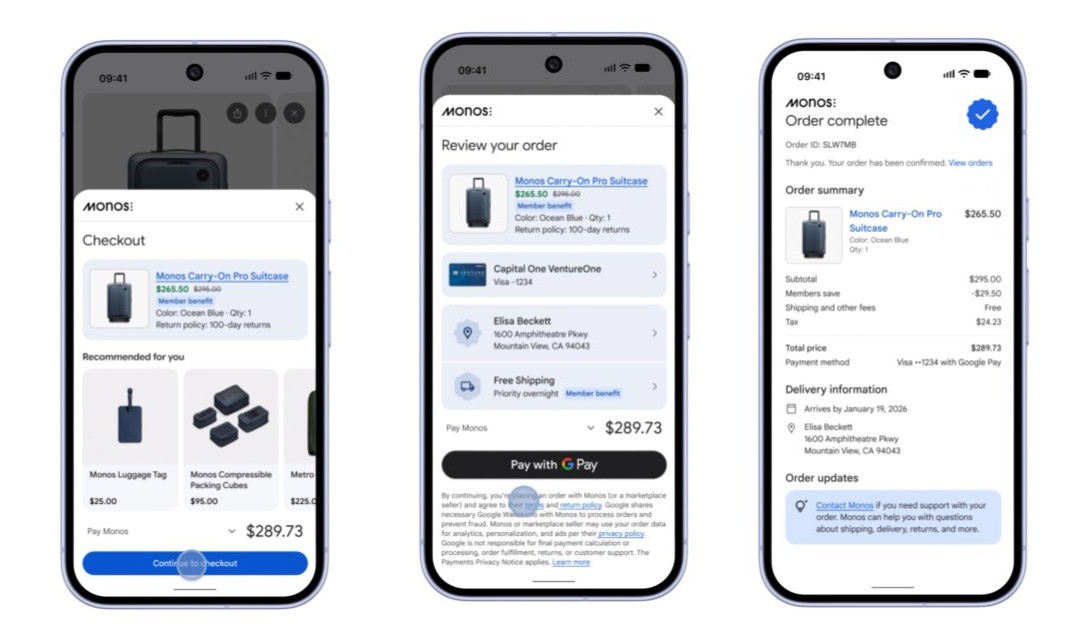
A human lands on a product page, sees the promo banner, scrolls through the photos, reads a few reviews, hesitates, comes back the next day. An AI agent does something else: it reads the page content, picks up the price, availability and specs, compares with other sites and leaves. It does not scroll and does not react to your visuals.
“An agent reads the product page, compares the price and leaves. In your numbers, it looks like a visitor who did not buy.”
As long as these visits stay mixed with human visits, they distort the metrics you look at every week. The most common effects:
| Metric | What happens | The risk |
|---|---|---|
| Conversion rate | Visits that cannot buy are added to the denominator | An apparent drop, with no real change among customers |
| A/B tests | Agents are split between variants like humans | Diluted gaps, longer tests, less reliable conclusions |
| Journeys | Very short visits, straight to the product page | “Exits” that look like friction |
| Heatmaps | Few clicks, no scrolling | Areas that seem ignored while humans do look at them |
| Bounce rate | One page read, then gone | Pages wrongly judged as weak |
Section 4 · A/B tests
In an A/B test, every agent counts as a visitor who does not buy
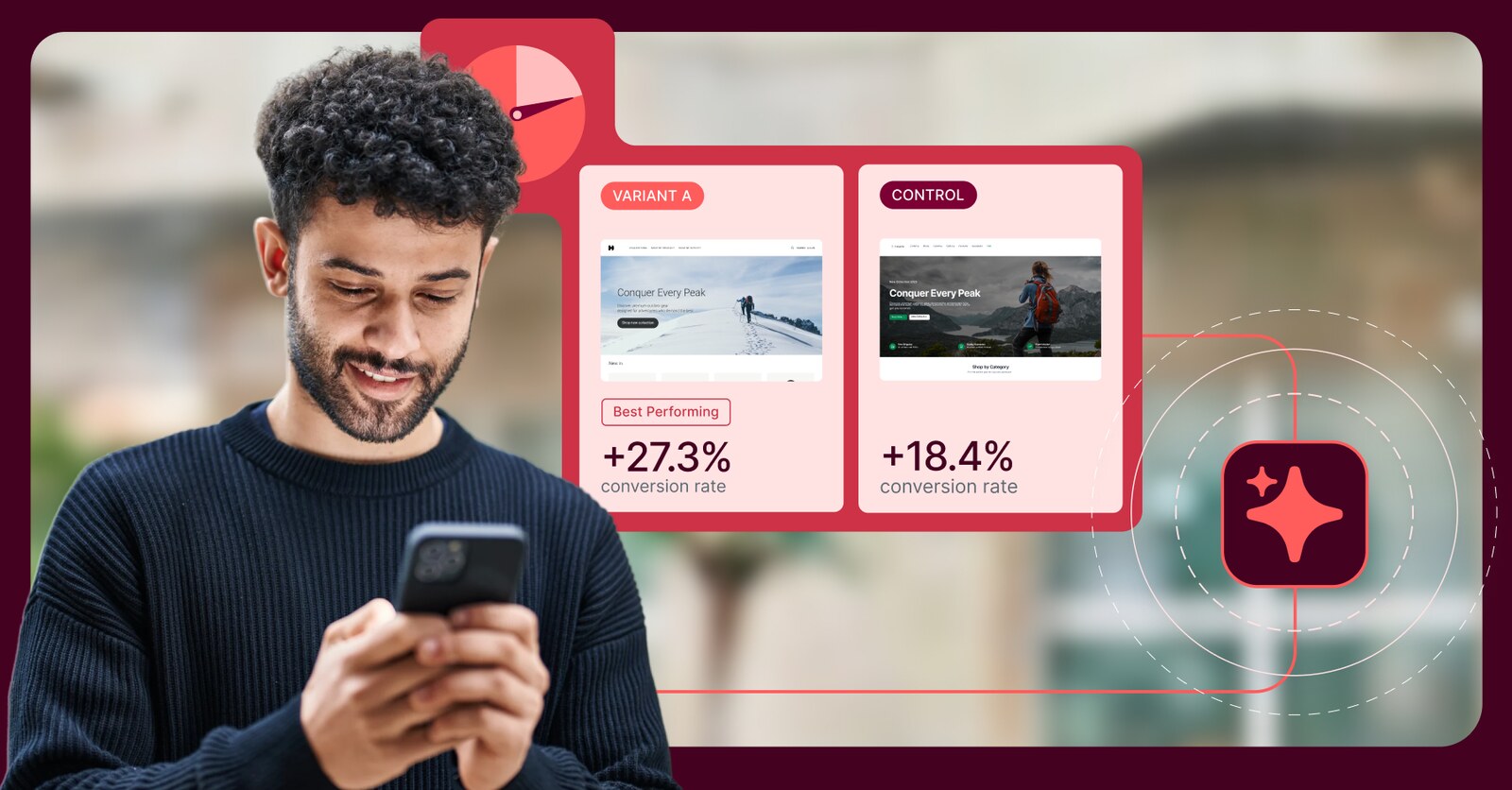
An A/B test compares two versions of a page on two randomly drawn groups of visitors. If some of those visitors are agents, two things can happen.
- 1NoiseAgents split roughly evenly between A and B. They buy in neither. The real gap between versions is diluted, and it takes longer to reach a reliable result.
- 2BiasIf a variant changes the page structure (price moved, content loaded later, a new block), agents may read it differently. They then behave differently in A and in B, and the result tilts one way with no change among humans.
- 3The decisionEither way, you risk keeping a variant that does nothing, or dropping one that worked with customers.
SRM, a first warning sign SRM (sample ratio mismatch) is an abnormal imbalance between the groups of a test: you planned 50/50, you get 52/48. It often means one type of traffic is counted differently on one side. Bot and agent traffic is one of the first causes to check.
This is where separating humans and agents becomes useful. If the analytics tool can recognize an agent session, you can remove it from the results, or study it on its own. Contentsquare integrates with testing tools such as Kameleoon, Optimizely and Dynamic Yield, which makes it possible to cross test results with the observed behavior of visitors.
Section 5 · The questions
Five questions to ask your team this week
For an e-commerce leadership team, the point is to know whether its numbers account for this traffic. The questions to ask:
- What share of our traffic is not human? Per month, per page, and especially on product pages.
- How do we spot it? Declared bots, behavior, bot-protection tool, analytics tool: each source gives a different number, so you need to know which one you are looking at.
- Is it excluded from our A/B tests? And since when. A test launched before that filter deserves a second look.
- Are our KPIs calculated on humans only? Conversion rate, bounce rate, average order value: you want the human version and the total version, side by side.
- What do agents do on our site? Which pages they read, which prices they pick up. That is what will be compared with competitors when a customer asks their AI assistant to choose.
The last question matters as much as the others. Keeping agents out of KPIs makes your numbers more accurate. Studying them separately tells you what AI assistants take away from your offer, and so what they will tell your customers.
Section 6 · What's next
Three things to watch in the coming months
- The detection method. Contentsquare's announcement does not explain how an agent is recognized. It is the first question to ask during a demo.
- The access timeline. The platform is in beta for selected customers. Check when your contract will give you access, and to which features.
- The WebMCP standard. If it spreads, agents will increasingly go through functions the site exposes to them, rather than reading pages. Measuring agent traffic will change again.
Key terms
ShowHide ⌄
- AI agent
- A program that acts on behalf of a person: looking for a product, comparing prices, sometimes buying.
- Agentic browser
- A web browser driven by an AI. It loads pages like a human, so your measurement tools may count it.
- LLM
- Large language model, the engine behind assistants such as ChatGPT, Claude or Gemini. It can send traffic to your site or read it directly.
- WebMCP
- A web standard in development that lets a site expose functions (search, add to cart) directly to AI agents in the browser.
- A/B test
- A comparison of two versions of a page on two randomly drawn groups of visitors, to measure which one converts better.
- SRM
- Sample ratio mismatch: an abnormal imbalance between the groups of a test, often caused by traffic counted differently on one side.
- Multi-touch attribution
- A method that spreads the credit for a sale across every touchpoint in the journey, instead of only the last click.
Sources
ShowHide ⌄
- Contentsquare, “Contentsquare Announces New AI-First Experience Platform to Optimize Every Human and Agent Journey”, October 13, 2026
- DataDome, “DataDome Report Finds Most Organizations Flying Blind as Agentic Traffic Surges”, March 5, 2026
- DataDome, “Businesses struggle to identify AI agent traffic”, March 2026
- CX Foundation, “Contentsquare relaunches platform”, October 13, 2026
Alexandre co-founded and runs Henkan & Partners. He decodes one e-commerce story every day on LinkedIn.
Follow Alexandre ↗