Shopify's AI-referred orders tripled in a year: why the product page is becoming the entry page
 Alexandre Suon·7 min read·
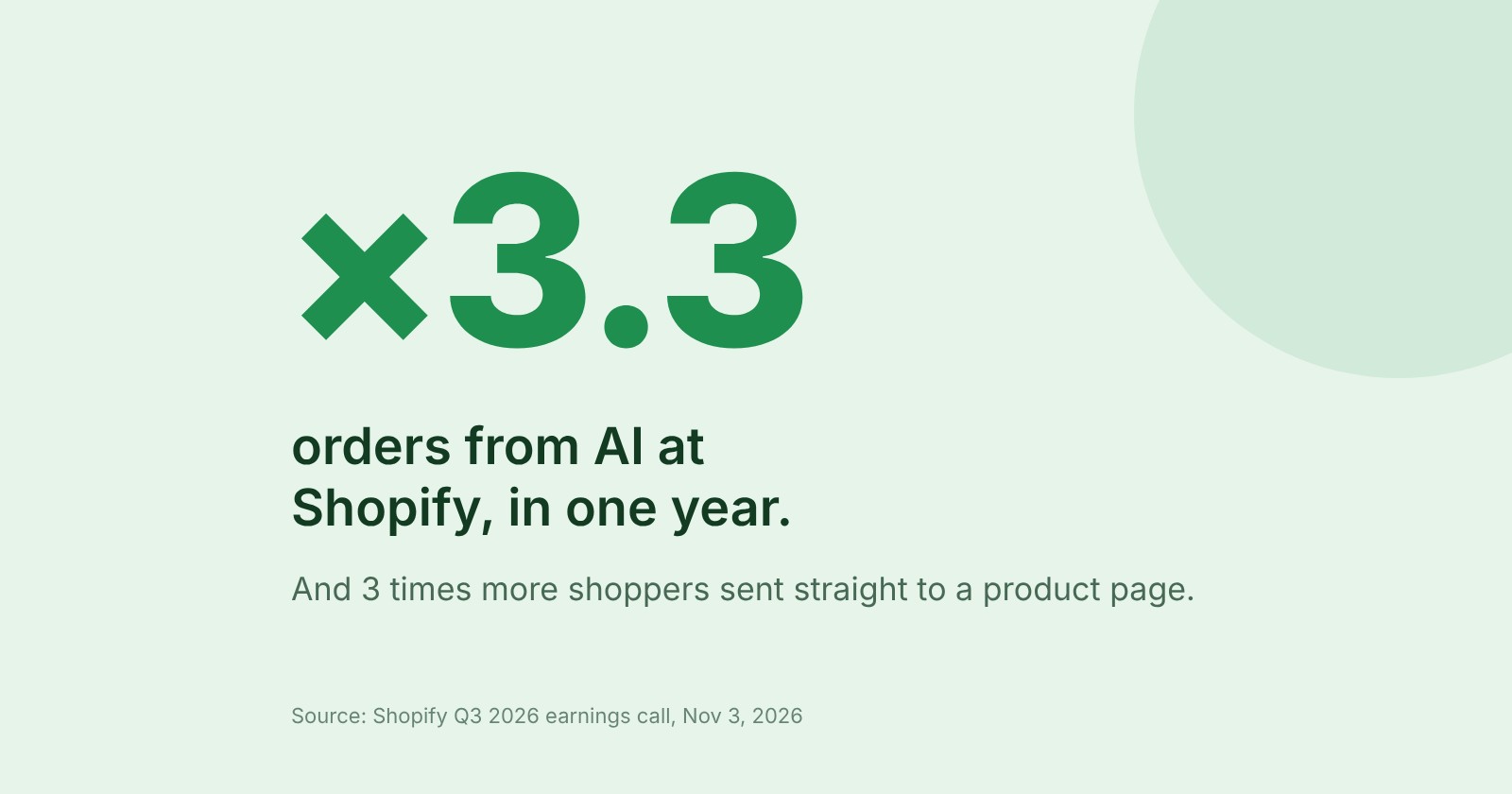
With its Q3 2026 results, Shopify detailed how much AI now weighs in its merchants' sales: traffic up 2.6x, orders up 3.3x, and shoppers sent straight to product pages. What the figures say, what they don't, and what changes for an e-commerce leadership team.
In this articleShow all sectionsHide
30-second summary
ShowHide ⌄
- On 3 November 2026, Shopify published its Q3 results: revenue up 32%, and $119 billion in gross merchandise volume (GMV) processed for its merchants.
- On the earnings call, President Harley Finkelstein broke out the role of AI: AI-referred traffic up 2.6x year on year, orders up 3.3x. Volume is still small, he added.
- AI channels send shoppers straight to product pages at 3x the rate of organic search. And searches powered by Shopify Catalog, its structured catalog built for AI, convert at 2x the rate of general AI search.
- According to the CFO, three quarters of AI-referred sales came from categories outside Shopify's top 100: the long tail benefits.
- For an e-commerce leadership team, two consequences: the product page becomes the entry page, and product data quality becomes a conversion lever.
Section 1 · The announcement
Traffic up 2.6x, orders up 3.3x: AI's share in Shopify's results
Shopify, the platform millions of brands use to sell online and in store, published its Q3 results on 3 November 2026. Revenue grew 32%, it processed $119 billion in GMV for its merchants, and its free cash flow margin was 22%.
In the release, President Harley Finkelstein summed up the strategy: keep building commerce "into every surface, every agent, and increasingly, everywhere". On the call with analysts, he gave the AI figures.
Orders are growing faster than traffic: this traffic converts better. Harley Finkelstein said AI-referred shoppers convert 64% more often. He also added a caveat: volume is still small. These multiples start from a modest base.
AI-referred traffic, explained These are visits that reach a store from an assistant such as ChatGPT, Gemini, Claude or Perplexity: the shopper asks a question, the assistant recommends a product with a link, the shopper clicks. In analytics tools, part of this traffic is misattributed and ends up in "direct".
Section 2 · The product page
AI sends shoppers straight to the product page, at 3x the rate of organic search
The most useful figure for an e-commerce team is elsewhere. According to Harley Finkelstein, AI channels send shoppers straight to product pages at 3x the rate of organic search.
A visitor coming from an AI has already done the sorting elsewhere: described the need, compared, received a recommendation. They skip the home page, the category page and the filters. They land on a product page with one question: is this the right one?
| Classic visitor | Visitor from an AI | |
|---|---|---|
| Landing page | Home, category, search results | Product page |
| What they've already done | Little: they're discovering | Described the need, compared, got a recommendation |
| Their question | What's available? | Is this the right one, at the right price, delivered in time? |
| What makes them buy | Navigation, choice, inspiration | Answers on the page: price, stock, delivery, returns, reviews |
Many test roadmaps still focus on the home page and category pages. Those pages still matter for classic traffic. But the visitor from an AI skips them: for them, the product page is the home page, the category page and the reassurance page all at once.
Section 3 · Product data
With a structured catalog, AI search converts at twice the rate
Shopify built Shopify Catalog, a catalog designed to be read by AI. According to Harley Finkelstein, it turns over a billion product pages into structured data: size, colour and material become values an agent can read and compare.
The stated result: Catalog-powered searches convert at 2x the rate of general AI search, where the AI rebuilds the information by reading store pages.
Structured product data, explained A product page written for a human puts everything in a block of text: "light jacket, slim fit, runs small". Structured data puts each piece of information in its own field: material, fit, size guide, stock, delivery time, return policy. An AI can then compare products without guessing, and recommend the one that answers the question exactly.
For a brand, the consequence is direct: what the AI can read, it can recommend. A missing attribute, a wrong stock level or a missing delivery time, and the product drops out of the answer, or appears in it with an error that will bring a disappointed shopper back.
Section 4 · The long tail
Three quarters of AI-referred sales come from outside the top 100 categories
Shopify's CFO, Jeff Hoffmeister, added a figure: in Q3, three quarters of AI-referred sales came from product categories outside Shopify's top 100. The figure was given as 74% during the analysts' questions.
Shopify's explanation: AI rewards specificity. A shopper who describes a very specific need gets a very specific product. A niche product, invisible at the bottom of a category page, can become the exact answer to a question asked to an AI.
“The product nobody found at the bottom of the category page can become the exact answer to a question asked to an AI.”
Section 5 · What changes
What changes for an e-commerce leadership team
A caveat first. AI traffic converting better does not prove that AI creates extra sales: these visitors have often compared before clicking, they arrive ready to buy. The figures mainly tell you where these shoppers land and what makes them buy. That is where the levers are.
- Isolate this traffic in your analytics: a dedicated channel for AI assistants, and an eye on the share lost in "direct".
- List your product pages most visited from AI and test them first, before the home and category pages.
- Check that each page answers immediately the questions of a shopper who has already decided: price, stock, delivery, returns, reviews.
- Audit your product data: complete attributes, size guide, materials, accurate availability, consistency between the site and the feeds.
- Look at the long tail: are your niche product pages as polished as your best-sellers?
One organisational question comes up often: who, in the company, owns product page quality? Merchandising, content, SEO, tech? In many teams, the answer is nobody in particular. With AI traffic, that question becomes a conversion question.
Key terms
ShowHide ⌄
- AI-referred traffic
- Visits that reach a site from a conversational assistant (ChatGPT, Gemini, Claude, Perplexity…) after a recommendation.
- GMV
- Gross Merchandise Volume: the total value of orders a platform processes for its merchants over a period.
- Structured product data
- Product information stored in precise fields (material, size, stock, delivery, returns) rather than buried in text, so a machine can read and compare it.
- Shopify Catalog
- Shopify's catalog that turns its merchants' product pages into structured data readable by AI.
- Long tail
- The many niche products that each sell in small quantities, but add up to a large share of sales.
Sources
ShowHide ⌄
Alexandre co-founded and runs Henkan & Partners. He decodes one e-commerce story every day on LinkedIn.
Follow Alexandre ↗