AI saves time, but nobody decides where it goes: what the Payscale study means for e-commerce teams
 Alexandre Suon·7 min read·
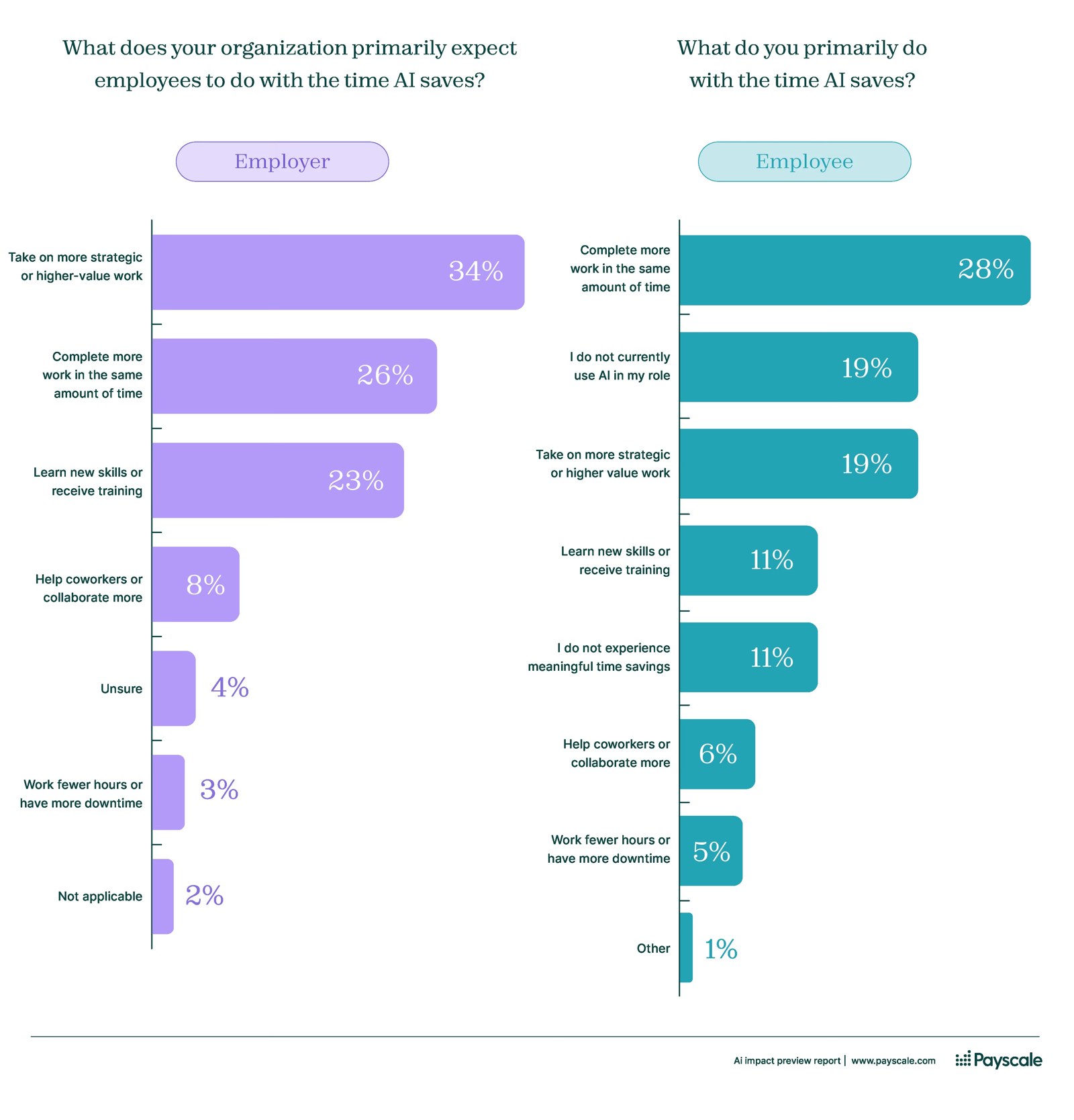
Payscale surveyed 500 HR leaders and 1,000 employees. 34% of employers want the time AI saves to go to more strategic work. Only 19% of employees say that is what they do with it. What the study measures, why the gap matters for an e-commerce team, and the questions to raise with the leadership team.
In this articleShow all sectionsHide
30-second summary
ShowHide ⌄
- Payscale published its AI Workforce Impact Report on 10 November 2026, based on two online surveys run in August 2026: 500 HR, compensation and talent acquisition leaders, and 1,000 full-time employees.
- 34% of employers expect the time AI saves to go to more strategic work. Only 19% of employees say that is what they do with it.
- The most common employee answer: doing more work in the same time (28%). 19% don't use AI in their role and 11% see no meaningful time savings.
- 61% of employees say AI saves them less than 10 hours a week.
- For an e-commerce team, hours saved with no destination get diluted: more content, more emails, not necessarily more results. Someone has to decide what they are for and which metric should move.
Section 1 · The study
Two surveys, 1,500 respondents, one question about time saved
Payscale, a compensation data company, published its AI Workforce Impact Report on 10 November. The study rests on two online surveys run in August 2026 by Dynata. The first covers 500 HR, compensation and talent acquisition leaders at organisations with 100+ employees. The second covers 1,000 full-time employees, also at organisations with 100+ people.
The report is mostly about pay and skills. But it asks both groups a simple question: what happens to the time AI saves? Employers say what they expect. Employees say what they actually do. The two answers don't match.
What the study can tell you, and what it can't The two samples are separate: the employees surveyed don't necessarily work for the employers surveyed. Answers are self-reported, and Payscale itself notes they may reflect intent more than action. The findings apply to organisations with 100+ people. The study gives an order of magnitude and a perception gap, not a productivity measure.
Section 2 · The gap
34% of employers expect strategic work, 19% of employees say they do it
On the employer side, the top expectation is clear: 34% want the time saved to go to more strategic or higher-value work. On the employee side, only 19% say that is what they do with it. The most common answer is elsewhere: 28% simply do more work in the same time.
The sharpest gap is on strategic work: 15 points. Learning follows the same pattern: 23% of employers expect it, 11% of employees do it. Only one answer where reality beats expectation: doing more work in the same time.
The employee survey adds two answers employers were not offered. 19% don't use AI in their role, and 11% say they see no meaningful time savings. So nearly one employee in three is out of the picture. On volume, 61% of employees say AI saves them less than 10 hours a week.
Section 3 · The rest of the report
Companies are rewriting roles faster than pay
The rest of the report shows organisations moving on roles and much less on pay. The main figures:
| Figure | What it measures | Respondents |
|---|---|---|
| 74% | Expect AI to affect headcount or hiring plans in the next 12 months | Employers |
| 61% | Are rewriting job descriptions because of AI | Employers |
| 49% | See their salary structures struggling to keep pace | Employers |
| 48% | Say market benchmarks no longer reflect the skills required | Employers |
| 40% | Struggle to find candidates with enough AI fluency | Employers |
| 74% | Plan AI-related upskilling in the next 12 months | Employers |
| 56% | Think people who build AI skills should earn more | Employees |
| 16% | Got a raise from AI-related upskilling (70%: no change) | Employees |
The common thread with the time question: companies know the work is changing, but they have not yet decided what they expect from it, or how to recognise it.
Section 4 · In e-commerce
Hours saved with no destination turn into volume
In an e-commerce team, AI already saves time in specific places. Writing product pages. Producing visual variants. Building CRM segments. Writing an analytics query. On each of these tasks, the gain is real and often quick.
The risk is the one the study shows: with no destination, saved time turns into volume. More product pages, more banner variants, more emails sent. Activity goes up. Results don't necessarily follow. A CRM base that gets twice as many messages does not convert twice as much.
Why “more work in the same time” is not enough Producing faster is a gain. It becomes a result when you know what the extra output changed: a conversion rate, an average order value, retention. Without that measure, the team sees it did more, without knowing whether it did better.
The same hours can go elsewhere. Launching more A/B tests. Analysing results before launching new ones. Spending time with customers: reading reviews, listening to customer service, watching sessions. These are exactly the tasks that get pushed back for lack of time.
“Time saved that nobody measures is just an impression.”
Section 5 · For the leadership team
Three questions for the leadership team
Ask these questions task by task. They turn a feeling of gain into a decision.
- Which task did AI replace, exactly? Name the task, the team and how long it took before. “We're faster on content” is not enough.
- What is the freed-up time for? More tests, more analysis, more time with customers. An explicit choice, written down, shared with the team.
- Which metric should move? For example the number of tests launched per month, or the time from idea to live. A starting value, a target, a date.
Section 6 · Where to start
Where to start this month
- 1List the tasks where AI already helpsProduct pages, visuals, segments, analytics queries. For each: who does it, how long it used to take, how long it takes now.
- 2Pick one destination per teamOne priority use for the freed-up time. A CRM team might choose campaign analysis, a product team might choose testing.
- 3Set a metric and its starting valueTests launched per month, time from idea to live, share of tests analysed to the end. Write down today's value before changing anything.
- 4Review in three monthsDid the metric move? If not, the time went somewhere else. You need to know where.
Key terms
ShowHide ⌄
- Self-reported data
- Answers people give about their own situation, with no outside measurement. Useful for perceptions, less so for actual behaviour.
- Higher-value work
- Payscale's wording: “more strategic or higher-value work”. The study does not define it further, so each company has to say what it means by it.
- Time from idea to live
- The time between when a test or improvement idea is written down and when customers can see it.
- Test velocity
- The number of A/B tests launched over a given period, often per month. A simple measure of how fast a team can learn.
- Salary structure
- The pay ranges a company attaches to each job level.
Sources
ShowHide ⌄
Alexandre co-founded and runs Henkan & Partners. He decodes one e-commerce story every day on LinkedIn.
Follow Alexandre ↗