One martech tool in seven has changed owner since 2023: what serial acquisitions change for e-commerce teams
 Alexandre Suon·8 min read·
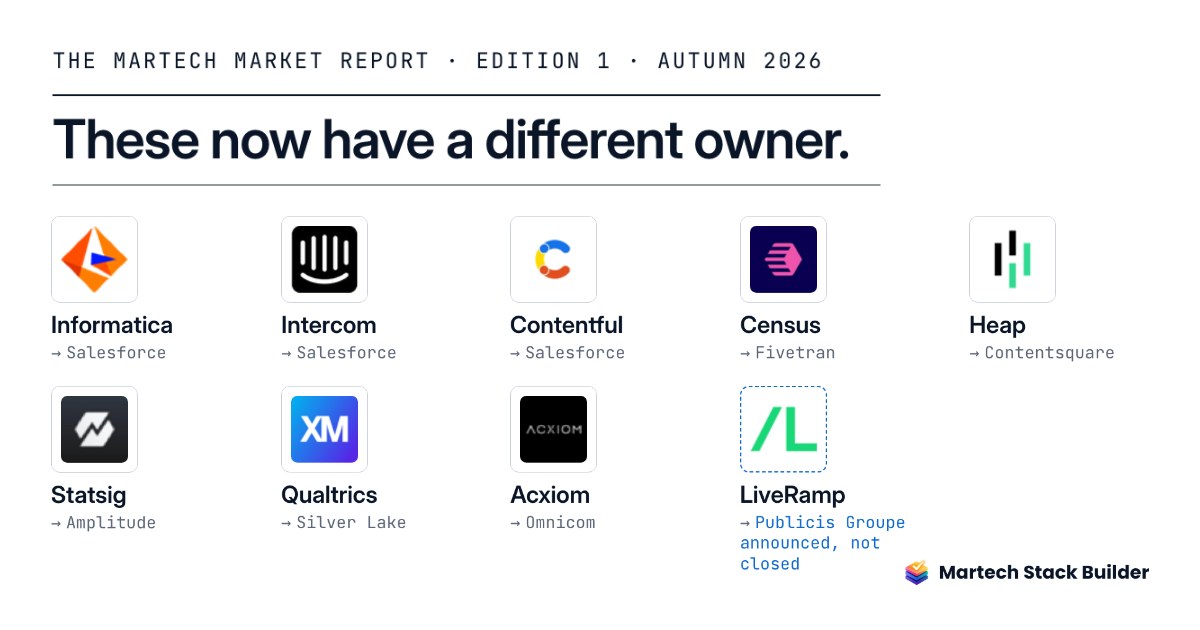
The Martech Market Report reviewed 464 vendors and checked every deal against its source: 68 tools have changed hands since 2023, and the pace is picking up. What the report measures, what an acquisition really changes for an e-commerce team, and three questions to ask before you sign.
In this articleShow all sectionsHide
30-second summary
ShowHide ⌄
- The Martech Market Report, published by Martech Stack Builder, reviewed all 464 vendors in its catalogue. Research closed on 11 October 2026.
- 68 products have been bought, merged, taken private or sold on since 2023: one in seven.
- The pace is picking up: 8 ownership changes in 2023, 14 in 2024, 25 in 2025 and already 21 in 2026 as of 11 October.
- Tools that changed hands publish their price less often: 32% show a starting price, against 44% for the others.
- An acquisition changes little on announcement day and a lot at renewal. The real risk is the data and learnings that don't move with you.
Section 1 · The report
464 vendors reviewed, every deal checked against its source
Martech Stack Builder, a tool for mapping and evaluating marketing stacks, published the first edition of The Martech Market Report in October. The team went through the 464 vendors in its catalogue, 88 of them not yet published on its site, and looked up who owns each one today, what it is called now and whether it shows a price.
The method is what makes the report useful. For each vendor, an AI researcher listed ownership events since 1 January 2023 and quoted the sentence from the primary source that states each one: a press release, an investor relations page or a regulatory filing. A script then checked that sentence against the page it came from. An event only appears in the report if it passed that check or a person verified it. 20 events found but not verified are left out of every figure.
A limit the report owns up to The catalogue lists tools that exist today. A tool bought and shut down in 2023 is not in it, and older deals are harder to find online. The authors ask readers to treat the early years as a floor, not an exact count. The trend will show from one edition to the next, measured the same way.
Section 2 · The numbers
68 tools have changed hands, and the pace is picking up
Out of 464 products, 68 have been bought, merged, taken private, sold on or agreed to be sold since 2023. That is one tool in seven. The report also counts 34 renames, 5 of them tied to AI or agents.
Who is buying? Mostly other software companies, then private equity. The report also points to a quieter trend: agency holding groups and data companies are buying the identity and data layer that audiences are built on.
The tools an e-commerce team uses every day are part of it: analytics, A/B testing, CRM, loyalty. A few examples from the report's deal list:
| Tool | Used for | What changed | Date |
|---|---|---|---|
| Heap | Product analytics | Bought by Contentsquare | Dec 2023 |
| SiteSpect | A/B testing | Bought by Monetate | Jun 2025 |
| AB Tasty | A/B testing | Merged with VWO, then joint Wingify brand | Jan and Sep 2026 |
| Statsig | Experimentation | Handed by OpenAI to Amplitude | May 2026 |
| Bluecore | Retail marketing | Bought by Insider One | May 2026 |
| Talon.One | Loyalty and promotions | Bought by Adyen | Jul 2026 |
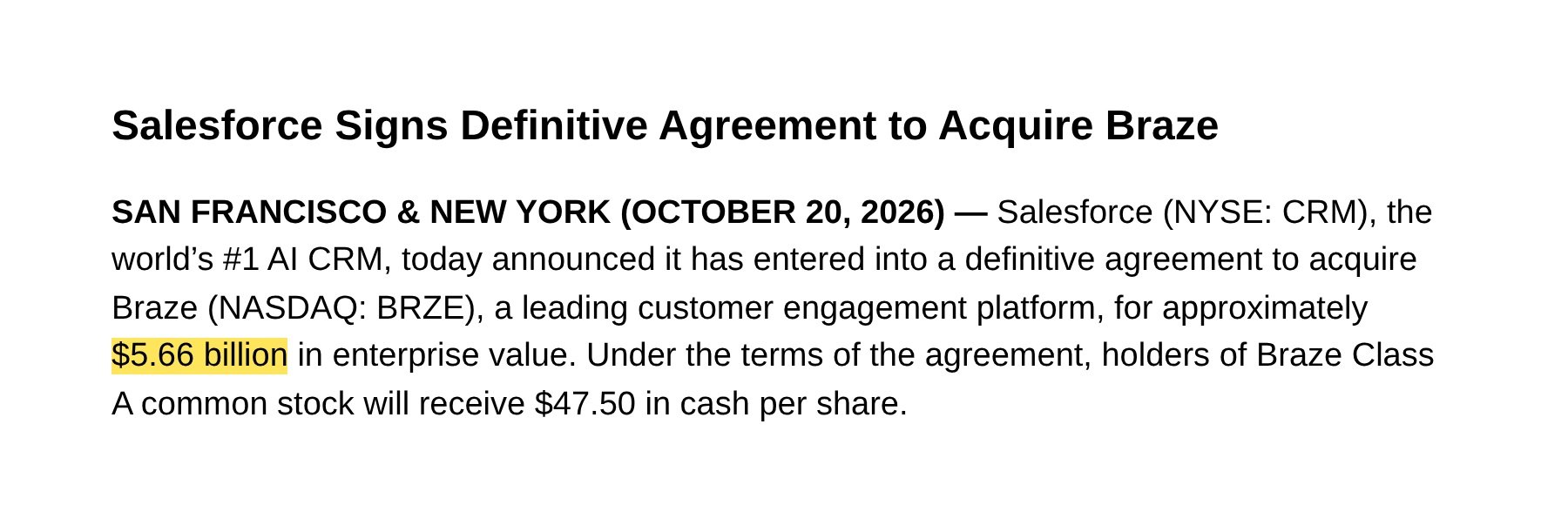
The list kept growing after the report closed: on 20 October, Salesforce signed a definitive agreement to buy Braze. We covered how that acquisition will unfold.
Section 3 · At renewal
An acquisition changes nothing on announcement day. It changes a lot at renewal
On the day a deal is announced, the tool works as it did the day before and the current contract still applies. The changes come later, often at renewal: the new owner reviews the price, the roadmap and the integrations it considers a priority, usually those with its own products.
The report gives a concrete example. After Fivetran bought it, the data activation tool Census was folded into its buyer's platform as Fivetran Activations and moved onto Fivetran's consumption-based pricing. Same job, new pricing model.
Pricing also gets harder to read. Across the whole catalogue, 42% of vendors show a starting price on their site. The gap between acquired tools and the rest is clear:
What a gap in published prices means for you A tool with no public price is sold on quote. You have fewer points of comparison, and how the price moves from one renewal to the next depends more on negotiation. The report does not say acquired tools cost more: it finds they show their price less often.
Section 4 · What stays stuck
The real risk is what doesn't move with you
Switching tools is never simple, but a contract can be renegotiated and an integration rebuilt. What costs most is what the team has built up inside the tool over the years and that doesn't come out cleanly:
- A/B test history: hypotheses, variants, results and decisions. If it only lives in the testing tool, it goes with it, and the team ends up re-running tests it has already run.
- CRM segments: the rules that define a loyal customer, an at-risk customer or an abandoned cart are often written in the tool's own logic.
- The tracking plan: events and their properties are often named the tool's way. On switch day, dashboards and year-on-year comparisons break.
“An acquired tool is often still a good tool. You just need to choose it knowing it may change hands.”
Section 5 · Before you sign
Three questions to ask before every signature
These questions apply to a new tool as much as to a renewal. They are not about avoiding vendors that might be bought, which is impossible at one in seven, but about staying in control if it happens.
- Can we export all our data, in a readable format, at no extra cost? Ask for the list of what can be exported (raw data, configuration, segments, history) and in which format.
- What does the contract say if the vendor changes owner? Look at the commitment term, renewal terms, notice period and price protection.
- Are our learnings stored with us, or only in the tool? Test results, segment definitions and the tracking plan should live somewhere you own.
Section 6 · Where to start
Where to start this week
- 1List your tools and their renewal datesA simple table is enough: tool, use, current owner, contract end date, notice period.
- 2Check who owns each tool todayThe report's deal list, each entry linked to its source, is a free download. Compare it with your table.
- 3Run a real exportFor the tools that hold your test history, segments or tracking, do a full export now, not on the day you need it.
- 4Prepare the next renewalAdd the three questions to your negotiation grid and get the answers written into the contract.
Key terms
ShowHide ⌄
- Martech
- The software marketing and e-commerce teams use: analytics, A/B testing, CRM, email, personalization, customer data management.
- Take-private
- The purchase of a listed company by a private equity firm, which delists it. The product keeps running under a new owner.
- Published starting price
- A price the vendor shows on its own site, as opposed to a rate you can only get through a quote.
- Tracking plan
- The list of events measured on a site or app (product view, add to cart, purchase) with their names and properties.
- Reversibility
- The ability to leave a tool and take your data with you in a usable format, as written into the contract.
Sources
ShowHide ⌄
Alexandre co-founded and runs Henkan & Partners. He decodes one e-commerce story every day on LinkedIn.
Follow Alexandre ↗