Salesforce buys Braze: how an acquisition works, and what CRM teams should secure now
$5.66 billion for the tool that sends the messages of thousands of brands. What Braze is, how an acquisition unfolds, what it changes for your contracts, and the inventory to start now.
In this articleShow all sectionsHide
30-second summary
ShowHide ⌄
- On October 20, 2026, Salesforce signed an agreement to acquire Braze for about $5.66 billion, paid in cash.
- That is almost 7.7 times Braze's annual revenue. Salesforce is paying for the real-time engine its AI agents need.
- An acquisition takes months: shareholder vote, regulatory approval, then closing, expected between February 2027 and January 2028.
- Until then, your contracts don't change. The risk is the dependency that follows: roadmap, pricing, integrations.
- The priority: document outside the tool what drives your CRM performance, starting with test results.
Section 1 · The announcement
Salesforce puts $5.66 billion on the table for Braze
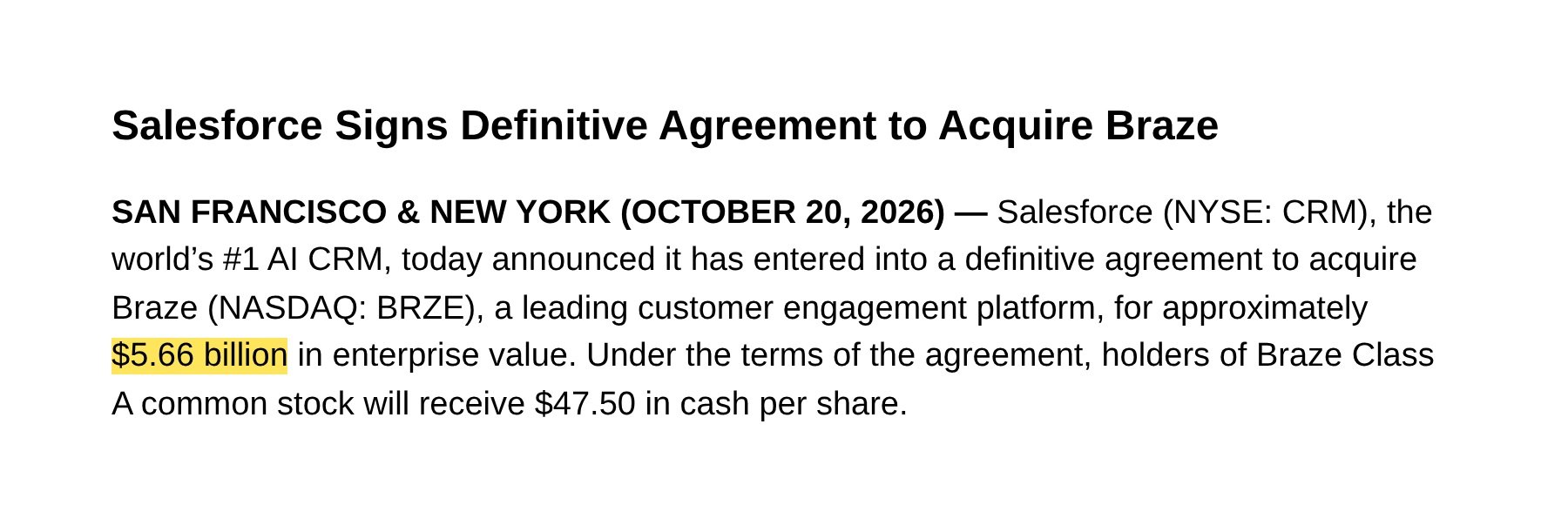
On October 20, 2026, Salesforce announced a "definitive agreement" to acquire Braze. The price: about $5.66 billion in enterprise value. In practice, each Braze shareholder will receive $47.50 in cash per share when the deal closes.
Braze reports about 2,770 customers. Its two co-founders, Bill Magnuson and Jon Hyman, would join the Marketing Cloud teams, Salesforce's marketing offering. The deal still needs approval from Braze shareholders and from competition authorities. Salesforce expects it to close in its fiscal year 2028, which runs from February 2027 to January 2028.
Enterprise value or price per share? The price per share ($47.50) is what each shareholder receives. Enterprise value ($5.66 billion) is the price of the whole company, after subtracting its cash and adding its debt. It's the figure used to compare acquisitions with each other.
Section 2 · The tool
Braze decides which message to send, to whom and when
Braze is what's called a customer engagement platform. For a CRM team, it's the everyday tool: you build segments there ("customers who bought twice and haven't ordered in 60 days"), you design journeys (welcome, abandoned cart, win-back), and it sends the messages on every channel: email, push notification, SMS, in-app message.
Its strength is real time. When a customer views a product, abandons a cart or opens the app, Braze can react within a second, with a message tailored to that customer. That's what made it popular with e-commerce brands and mobile apps.
Section 3 · The mechanics
An acquisition takes months, and nothing changes before closing
When you read "Salesforce buys Braze", you assume it's done. In reality, the announcement is only the beginning. Acquiring a listed company usually follows five steps.
- 1Definitive agreement · Oct 20, 2026Both boards sign the terms: price, payment method, timeline, fees if one party walks away.
- 2Shareholder voteBraze shareholders vote to accept, or not, the $47.50 per share offer.
- 3Competition authoritiesThey check that the deal doesn't reduce competition too much. They can approve it, set conditions or block it.
- 4Closing · Feb 2027 to Jan 2028Shareholders are paid, Braze leaves the stock market and belongs to Salesforce. Only then is the acquisition done.
- 5Integration · the following yearsTeams, products and commercial offers converge. That's when customers really feel the change.
Between announcement and closing, Braze and Salesforce remain two independent companies. They may not act as if the deal were already done: no joint pricing, no bundled offer. For a Braze customer, nothing changes in that period: not the contract, not the support, not the announced roadmap.
Section 4 · The strategy
Salesforce is paying for the engine its AI agents need
Salesforce says Braze will strengthen Marketing Cloud's cross-channel personalization and plug into its whole stack: data (Data 360), customer relationship (Customer 360) and AI agents (Agentforce).
The logic is simple. An AI agent that wants to re-engage a customer at the right time needs three things: know the customer, decide on the right message, and send it on the right channel. Salesforce had the first two. Braze brings the third, in real time.
What does "7.7 times revenue" mean? The price of an acquisition is often compared with the target's revenue. Here, $5.66 billion divided by $738 million gives about 7.7. In other words, Salesforce is paying the equivalent of almost eight years of Braze sales. A buyer accepts that kind of price when it expects growth to continue, or the company to be worth more once integrated.
“You can replace the tool. Not the history of what works with your customers.”
Section 5 · The precedent
ExactTarget shows where Braze will probably end up
Salesforce has been down this road. In 2013, it bought ExactTarget, then one of the email marketing leaders, for about $2.5 billion. The tool became the foundation of Marketing Cloud. Thirteen years later, Salesforce is paying more than twice as much for the next generation: a real-time, cross-channel, mobile-first engine.
Section 6 · Your contracts
Your contracts stay valid, the dependency comes later
In a share acquisition like this one, Braze keeps existing as a company. Your contract therefore generally remains valid until its end date, on the same terms. What can change is what happens at renewal, and during integration:
- The roadmap. Product teams work on integration with Marketing Cloud and Agentforce first. What was promised for next year may slip.
- Pricing at renewal. Especially when the tool becomes part of a bundle with the buyer's other products.
- Integrations. Those with the buyer's competitors become less of a priority, for data as well as analytics.
- Your contacts. Sales and support teams are often reorganized in the months after closing.
The change of control clause Some software contracts set out what happens if the vendor changes owner: a right to terminate, to renegotiate, or guaranteed terms. Review your Braze contract with your legal or procurement team to see whether it has one.
Section 7 · Your options
Three options, depending on your place in the Salesforce ecosystem
There's no single right answer. It all depends on the tools you already use and when your contract ends.
| Option | For whom | What to do now |
|---|---|---|
| Benefit from the integration | Brands already on Salesforce (CRM, Commerce, Data 360) | Ask for the integration roadmap and migration terms |
| Stay, with protection | Satisfied brands renewing in 2027 | Negotiate price and term now, require a full data export |
| Prepare a possible exit | Brands built on another suite | Run the inventory below, then compare alternatives without rushing |
Section 8 · The plan
Three weeks are enough to get your knowledge out of the tool
The right question isn't "should we leave?" but "if we leave one day, what do we lose?". At many brands, a good part of CRM knowledge only exists inside the tool. Here's what to list:
- A/B test results on subject lines, creatives, send times and channels, with their hypotheses.
- Segments and their exact rules, not just their names.
- Journeys: triggers, delays, exit conditions, marketing pressure.
- Events and attributes sent by the site and the app, with their definitions.
- Message templates and their personalization rules.
- Integrations and inbound and outbound data flows.
Section 9 · What's next
Three signals to watch in the coming months
- The Braze shareholder vote and the competition authorities' decision.
- The first joint Braze and Marketing Cloud roadmap.
- The terms offered to Braze customers renewing in 2027.
Key terms
ShowHide ⌄
- Definitive agreement
- Contract signed by the buyer and the target that sets the price and terms. It is not yet the acquisition itself.
- Closing
- The moment the acquisition takes effect: the money is paid and the company changes owner.
- Enterprise value
- Price of the whole company, minus its cash and plus its debt.
- Revenue multiple
- Acquisition price divided by annual revenue. Here, about 7.7.
- Competition authority
- Public body that checks an acquisition doesn't harm competition.
- Change of control clause
- Contract clause that sets out what happens if the vendor changes owner.
- Customer engagement platform
- Tool that decides and sends messages (email, push, SMS, in-app) based on each customer's behavior.
- Fiscal year
- A company's accounting year. At both Salesforce and Braze, it ends in late January.