ElevenLabs launches Eleven Realtime: how a voice agent works, and how to measure it like a funnel
 Alexandre Suon·11 min read·
Models that listen and answer by voice in about half a second, in more than 90 languages. What a voice agent is, why latency changes everything, and how to run phone and WhatsApp as sales channels.
In this articleShow all sectionsHide
30-second summary
ShowHide ⌄
- On October 20, 2026, ElevenLabs launched Eleven Realtime, two voice models built for agents: v1 Mini and v1 Max.
- They listen and answer directly by voice, in more than 90 languages, with more than 17,000 voices available.
- According to Artificial Analysis measurements published by ElevenLabs, v1 Max starts answering in 0.57 seconds on average.
- They plug into phone, web and WhatsApp. Those channels become sales channels in their own right.
- A voice agent is managed like a funnel: calls answered, need understood, solution offered, sale closed.
Section 1 · The news
ElevenLabs ships two models built to talk in real time
ElevenLabs is known for its synthetic voices, used for dubbing, audiobooks and assistants. On October 20, 2026, the company launched Eleven Realtime, a new family of models designed for one thing: holding a spoken conversation in real time.
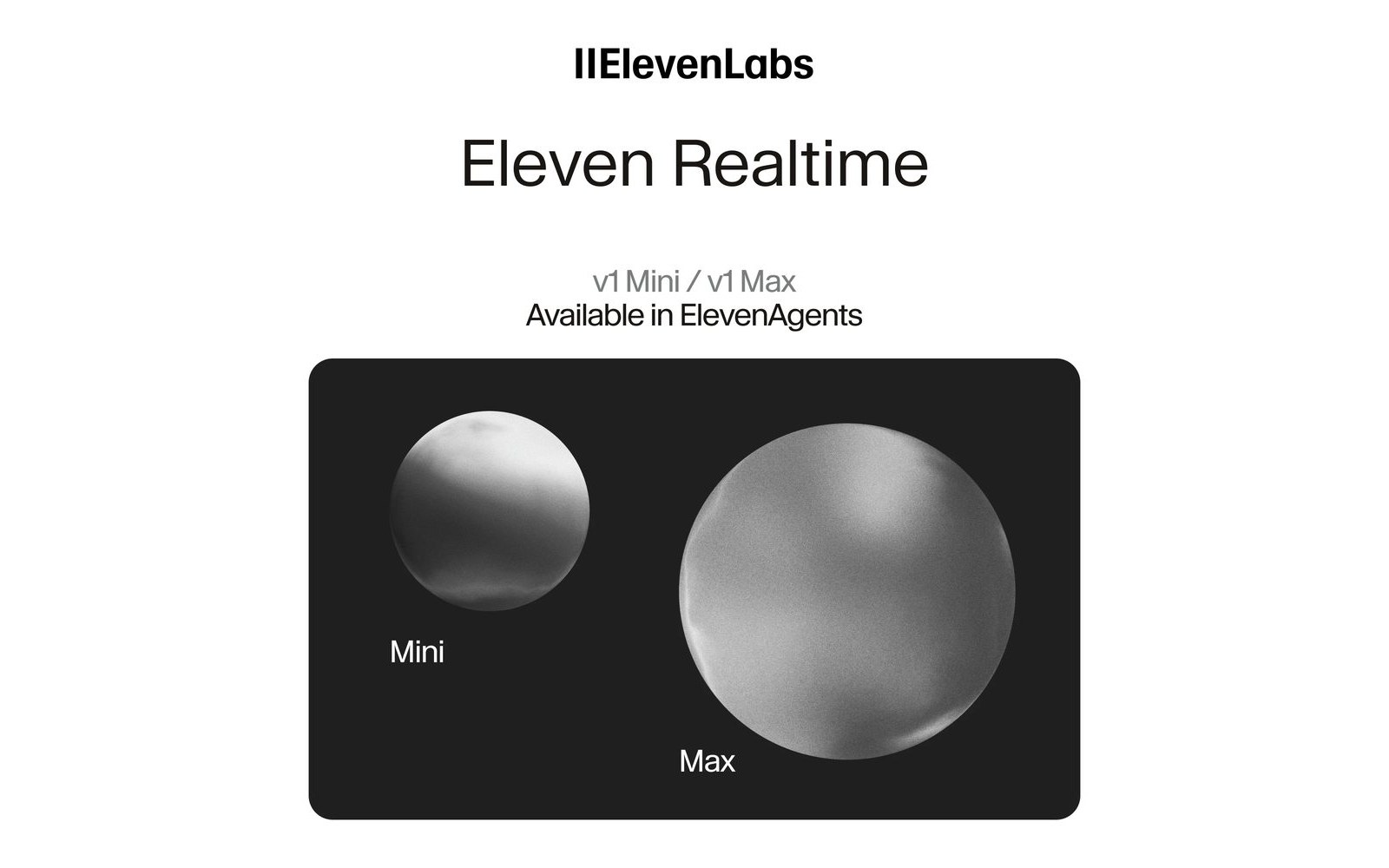
Two versions ship. v1 Mini targets natural conversations at low cost: assistants, tutors, interactive characters. v1 Max targets complex tasks: customer support, lead qualification, multi-step workflows. Both speak more than 90 languages and can use any of the 17,000+ voices in the ElevenLabs library.
They are available two ways: in ElevenAgents, ElevenLabs' tool for building and deploying agents, and through an API. ElevenLabs did not share pricing in its announcement.
Section 2 · How it works
A voice agent listens, thinks and answers, without talking over you
A voice agent is a program that holds a phone or voice conversation in place of a person. It has three jobs: understand what the person says, decide what to answer (and sometimes act, for example check an order), then answer out loud.
For a long time, those three jobs were handled by three separate tools chained together. Every hand-off adds delay, and some information gets lost on the way: tone, hesitation and irony disappear when speech is turned into text.
- 1The classic chain: three toolsSpeech is transcribed to text, a language model writes the reply, then a synthetic voice reads it. Easy to assemble, but each step adds delay.
- 2The speech-to-speech modelA single model listens to the voice and answers directly by voice. This is the category ElevenLabs places Eleven Realtime in.
- 3The actions around itEither way, the agent can call tools: check stock, find an order, book an appointment.
What does “full duplex” mean? In a real conversation, we speak and listen at the same time: we say “mm-hm”, we interrupt, we stop when the other person starts again. A full-duplex system handles that overlap. It is what separates a fluid conversation from an answering machine.
Section 3 · The numbers
Half a second to answer, and clear gaps between Mini and Max
ElevenLabs published test results run by Artificial Analysis, an independent firm that benchmarks AI models. The number that matters most in a conversation is time to first audio: the silence between the end of your sentence and the start of the reply.
On the other tests, the gap between the two models widens as soon as the task gets complex. For an agent that has to actually do things (find an order, change a delivery), the “tool-use tasks” row is the one to watch.
| Test | What it measures | v1 Max | v1 Mini |
|---|---|---|---|
| Big Bench Audio | Spoken reasoning (1,000 questions) | 98.8% | 75.9% |
| Full-Duplex-Bench | Conversational flow | 94.1% | 95.8% |
| Tool-use tasks | Tasks completed | 87.1% | 60.3% |
| Speech Agent Arena | Blind listener preference (score) | 998 | 988 |
How to read these numbers These are standardized tests, not your conversations. They compare models with each other; they do not predict your conversion rate. An agent that completes 87% of test tasks will still fail on part of your real calls: that is what you will need to measure yourself.
Section 4 · Channels
Phone and WhatsApp become sales channels again
Through ElevenAgents, these models plug into phone, web, WhatsApp and contact-center platforms. ElevenAgents also provides the building blocks around them: workflows, knowledge base, guardrails, testing and monitoring.
For an e-commerce team, that is the real story. Phone and messaging have often been treated as cost centers: measured in call duration and answer rate, rarely in revenue. When an agent can answer at any hour, in the customer's language, and recommend a product, those channels can sell.
Compatible with OpenAI's API: why it matters ElevenLabs says its realtime API is compatible with OpenAI's: you change the endpoint and the model name, and existing code keeps working. For your tech teams, trying another provider becomes a matter of hours, not weeks. That reduces dependence on a single vendor.
Section 5 · Measurement
A conversation is measured like a funnel, step by step
On a website, we know how to measure a funnel: page views, add-to-carts, orders. A voice conversation has exactly the same structure. Each step loses some customers, and that is where the gains are hiding.
- 1Call answeredHow many calls or messages get a reply, at what time, in which language.
- 2Need understoodDid the agent work out what the customer wants without making them repeat themselves?
- 3Solution offeredA product, a size, an in-stock alternative: did the agent make a concrete offer?
- 4Sale closedOrder placed during the conversation, or a link sent and used in the following hours.
- 5Handed to a humanWhen and why the agent hands over: that is the list of what it cannot do yet.
This breakdown changes the internal debate. Instead of arguing “is the agent good?”, you look at which step loses customers, and test one improvement at a time, exactly as you would on a product page.
Section 6 · What to test
Start small: one use case, one channel, one metric
A voice agent is easier to test on a narrow scope than on the whole customer service at once. The questions to answer before launch:
- Which use case? Order tracking, product advice, booking: pick the one with the most volume and the clearest rules.
- Which channel? WhatsApp is often simpler to launch than phone, and leaves a written trail that is easy to analyze.
- Which metric? A single success number, defined before launch: resolution rate, sales generated, or calls handed over.
- Which comparison? Part of the traffic with the agent, part without. Without a control group, you cannot know what it really brings in.
- Which guardrails? What the agent must never say or promise (prices, delivery dates, refunds), and when it must hand over.
“A voice agent is not a customer-service project. It is a new sales channel, measured and tested like the others.”
Key terms
ShowHide ⌄
- Voice agent
- A program that holds a spoken conversation in place of a person, and can act (check an order, book an appointment).
- Speech to speech
- A model that listens to speech and answers directly in speech, with no visible text step.
- Time to first audio
- The silence between the end of the customer's sentence and the start of the agent's reply. Above one second, the conversation feels slow.
- Full duplex
- The ability to speak and listen at the same time: handling interruptions, “mm-hm”s and turn-taking.
- CCaaS
- Contact Center as a Service: cloud-hosted contact-center software that manages calls and messages.
- Control group
- A share of customers who do not get the new feature. Comparing them with the rest measures the real effect.
Sources
ShowHide ⌄
Alexandre co-founded and runs Henkan & Partners. He decodes one e-commerce story every day on LinkedIn.
Follow Alexandre ↗